



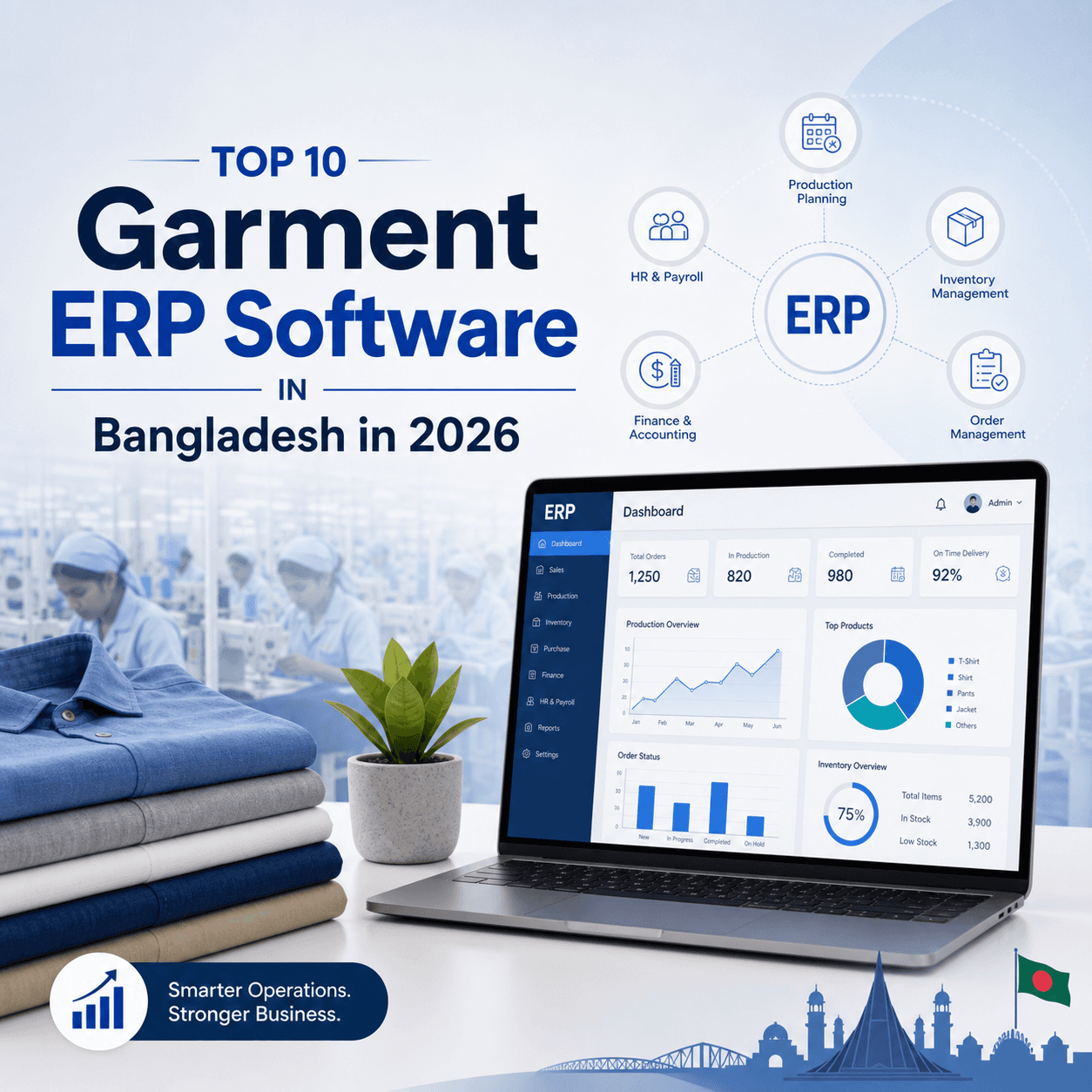
If you run a factory in 2026, you already know the real competition is not just on price. It’s on speed, compliance, and control. That’s exactly why Garment ERP Software has become a must-have in Bangladesh. The right Garment ERP Software helps you track orders, materials, production, quality, shipments, and finances in one connected system, instead of juggling spreadsheets and disconnected tools. And yes, choosing the “best” Garment ERP Software is not about picking the most famous name. It’s about what fits your workflows, your buyers, your reporting needs, and your growth plans.
Bangladesh has no shortage of options. You’ll see global suites, local specialists, and modern cloud-first platforms competing to be the best ERP software in Bangladesh for garments. In this guide, I’ll walk you through the top 10 ERP software in Bangladesh choices that garment businesses commonly shortlist in 2026, what each is good at, and how to pick confidently without getting stuck in long implementation cycles or surprise costs.
Why Garment Businesses In Bangladesh Are Upgrading ERP In 2026
The garment industry has gotten more data-heavy than ever. Buyers want faster updates, tighter compliance, and cleaner traceability. Factory owners want less leakage, fewer production surprises, and better cash planning. A modern Garment ERP Software bridges those goals by connecting merchandising to procurement, inventory, production, QC, finance, and dispatch.
In practical terms, the biggest wins usually come from better visibility into fabric and trims, tighter production planning, fewer stock mismatches, smoother subcontract tracking, and more accurate costing. That’s why you’ll hear garment teams also searching for inventory management software Bangladesh and warehouse management software Bangladesh then realizing they actually need a full garments ERP software Bangladesh setup that covers everything end to end.
What To Look For Before You Choose Garment ERP Software
Before you jump into demos, get clear on the “musts.” For most factories, the strongest Garment ERP Software options tend to share a few traits: they support garment-specific workflows (styles, sizes, colors, BOM, sampling, pre-production, cutting, sewing, finishing), they handle real-time inventory, and they can grow into multi-unit operations.
Here are the decision filters that matter most in Bangladesh, especially if you are comparing ERP software Bangladesh vendors side by side. First, check garment production depth: can it handle line planning, WIP, efficiency, and subcontracting properly? Second, check integrations: finance tools, barcode/QR scanning, and data import options. Third, check deployment: many teams prefer cloud ERP Bangladesh, but some still need hybrid or on-premise due to governance. Finally, ask upfront about the ERP software price in Bangladesh and the full ERP implementation cost Bangladesh, including training, data migration, customization, and support.

Top 10 Garment ERP Software In Bangladesh In 2026
Below are the most commonly shortlisted options for Garment ERP Software in Bangladesh right now. Some are garment-specialized, some are strong manufacturing suites, and some are broad ERPs with excellent customization for apparel.
1. Focus ERP (Focus 9 / Focus X / Focus WMS / Focus MRP / Focus POS)
If you want a modular, scalable system that can start small and expand, Focus is a strong contender for Garment ERP Software in 2026. Focus offers a suite approach: Focus 9 and Focus X as core ERP, plus Focus WMS, Focus MRP, and Focus POS as add-on modules. This modular design is particularly useful for garment businesses that want to begin with finance, inventory, HRMS, or CRM, and then grow into deeper production and warehouse control.
A big advantage is flexibility in deployment. Many companies evaluating cloud ERP Bangladesh like having cloud, on-premises, or hybrid choices without losing features. Focus also stands out for integrations (including popular accounting ecosystems) and for workflow automation. If your business has role-based approvals, multi-location controls, or frequent process changes, the zero-code workflow approach saves time and reduces dependency on developers. For growing groups, it supports single companies up to multi-country structures with granular security.
From a garment perspective, Focus fits especially well when you want a strong backbone for finance, inventory, purchasing, production planning, and warehouse scanning. Paired with WMS and barcode/QR, it becomes a practical manufacturing ERP software Bangladesh option for factories that want real-time stock accuracy and better dispatch discipline.

2. Farvision ERP
Farvision ERP is often considered by manufacturers that want structured processes and solid operational controls. For garment businesses, it can be configured as Garment ERP Software to manage production, material planning, and financial reporting while supporting multi-department workflows.
Farvision is usually a good fit when you need reliable reporting and a system that can be aligned with compliance requirements. Many teams evaluating ERP for manufacturing Bangladesh like Farvision when they want predictable governance, strong master data control, and a vendor-led implementation approach.
3. Impact+ ERP
Impact+ ERP is another option commonly considered in Bangladesh for companies seeking an end-to-end management platform with local implementation support. In garments, it can be positioned as Garment ERP Software for order processing, production coordination, inventory, and accounts.
Impact+ is often shortlisted by teams that want a balance between customization and usability, without going too enterprise-heavy. If you are an ERP software for SME Bangladesh buyer looking to digitize quickly, it can be worth putting on your ERP demo Bangladesh list.
4. SAP Business One (With Garment/Manufacturing Add-Ons)
SAP Business One remains popular for mid-sized and fast-growing companies that want stronger controls and standardization. As Garment ERP Software, it usually requires garment-specific add-ons or partner customization to cover apparel workflows properly.
Where SAP B1 shines is finance discipline, multi-branch governance, and reporting maturity. If you are aiming to meet strict audit expectations and want a globally recognized platform, it’s a solid candidate. Just be realistic about the ERP implementation cost Bangladesh for SAP projects, especially if you need deep garment production features.
5. Oracle NetSuite (Cloud ERP)
NetSuite is a true cloud-first suite and a common choice for groups that want modern reporting, multi-entity consolidation, and strong process visibility. If your leadership is pushing hard toward cloud ERP Bangladesh, NetSuite is one of the platforms that matches that direction, especially for businesses that manage multiple units, multiple countries, or complex approval structures.
As Garment ERP Software, NetSuite typically needs garment-specific configuration and sometimes partner extensions. It can be an excellent fit for export-oriented groups that want strong financial consolidation and standardized workflows across locations, but the licensing model can push the ERP software price in Bangladesh higher than local-first solutions.

6. Microsoft Dynamics 365 Business Central (With Apparel Extensions)
Dynamics 365 Business Central is widely used globally and works well in manufacturing and distribution. In Bangladesh, it’s often implemented through partners who add garment and textile extensions, turning it into effective Garment ERP Software for merchandising-to-delivery management.
It’s a strong pick if you want familiar Microsoft ecosystem integration, cleaner reporting, and a modern UI. Like other global platforms, the real outcome depends heavily on the partner’s industry knowledge, so treat your partner selection like selecting an ERP software company in Bangladesh that truly understands garments.
7. Odoo ERP (With Garments Customization)
Odoo has become a popular choice for businesses that want flexibility and modular apps. In garments, Odoo can be shaped into Garment ERP Software by customizing manufacturing, inventory, purchase, sales, and accounting flows around styles and production stages.
Odoo is often shortlisted by companies that want quicker iteration and a lower initial entry point. However, you must choose an experienced implementer to avoid customization bloat. It can be a good ERP software for SME Bangladesh route when you want control and modular scaling, but you should validate performance for large transaction volumes and shop-floor realities.
8. ERPNext (Open Source ERP)
ERPNext is another open-source ERP that can be adapted into Garment ERP Software with the right implementation team. It’s widely used for manufacturing, inventory, purchasing, sales, and accounts, and it can support barcode workflows as well.
ERPNext is attractive for teams that want transparency and long-term control over their system roadmap. It can also be a smart option when budgets are tight and you want a phased rollout. Still, garment-specific depth depends on how well the implementer understands production processes, especially for WIP tracking and line-level efficiency.
9. TallyPrime (With Garment/Inventory Add-Ons Or Integrations)
Tally remains extremely common as an accounting backbone. While it’s not a full Garment ERP Software by itself, many factories still run Tally for finance and connect it to production or inventory tools. If you are early in your digital journey, Tally can act as a bridge while you prepare for a full ERP rollout.
This approach can work when you need strong accounting right away and plan to layer manufacturing and warehouse systems around it. If you go this route, integration quality matters a lot. Weak integrations create duplicate work and reconciliation problems, which defeats the purpose of adopting Garment ERP Software in the first place.
10. Local Garments ERP Vendors In Bangladesh (Specialized Systems)
Bangladesh has several local vendors offering specialized garments ERP software Bangladesh solutions. These tools are often built specifically around local garment operations and can feel very practical out of the box. Many offer merchandising modules, sample tracking, production follow-up, and basic inventory and accounts.
The upside is local support and local process familiarity. The risk is scalability, product maturity, and long-term roadmap. If you shortlist a local system as your best garments ERP software in Bangladesh candidate, verify references, upgrade history, security practices, and the ability to handle multi-factory growth. Also confirm whether they can deliver reliable warehouse management software Bangladesh features like barcode scanning, bin locations, and cycle counts.
How To Compare ERP Software Price And Implementation Cost In Bangladesh (Without Guessing)
Most companies ask for the ERP software price in Bangladesh first, but the better question is the total cost of ownership over three years. A cheaper license with weak implementation can cost more than a higher license with a clean rollout.
The best way to compare is to ask vendors for a transparent breakdown: licensing (user-based or module-based), implementation services, customization, data migration, training, hardware or scanning devices, and ongoing support. Also ask how they handle change requests after go-live, because that’s where budgets often slip. This is especially important for Garment ERP Software projects where buyer requirements and production flows change frequently.
If you are buying ERP software Bangladesh options for a group, include multi-location needs from day one. If you are buying for a single unit, prioritize speed and adoption, then scale.
A Simple Shortlist Plan That Works In Real Factories
If you want a practical way to shortlist, start with your process map and your pain points, not a brand name. Decide whether you need a manufacturing-first system (deep production and WIP) or a finance-first system (strong accounting and reporting) and then see which Garment ERP Software aligns.
For most teams, the next step is requesting an ERP demo Bangladesh that uses your real scenarios: one real style, one real order, real fabric booking, real cutting plan, real line output, real QC, real shipment, and real costing. When vendors can run your scenario smoothly, you are close to a safe decision.
FAQs
What Is The Best Garment ERP Software For Bangladesh Factories In 2026?
The best Garment ERP Software depends on your size, workflows, and buyer compliance needs. Shortlist 3 to 5 options, run a real production-to-shipment demo, then compare support quality and total implementation cost.
How Much Is ERP Software Price In Bangladesh For Garments?
ERP software price in Bangladesh varies by users, modules, and deployment type. Expect costs to include licenses plus services like implementation, customization, training, and support. Always compare 3-year total cost, not just upfront pricing.
Is Cloud ERP Bangladesh Safe For Garment Data?
Cloud ERP Bangladesh can be safe when the vendor offers strong security, role-based access, audit logs, and reliable hosting. Ask about data location, backup frequency, disaster recovery, and user permission controls before signing.
How Long Does Garment ERP Implementation Take In Bangladesh?
A basic Garment ERP Software rollout can take 8 to 16 weeks, while multi-factory or heavily customized projects may take 4 to 9 months. Timelines depend on data readiness, process clarity, and user training.
What Should I Ask In An ERP Demo Bangladesh Session?
Ask vendors to demonstrate your real garment flow: order entry, BOM, fabric and trims booking, inventory receipt, cutting and sewing WIP, QC, packing, shipment, and costing. Also review approvals, reports, and mobile scanning.
Talk To Infoex Bangladesh
If you are serious about upgrading to Garment ERP Software in 2026, we can help you do it without confusion and without bloated complexity. At Infoex Bangladesh, we guide you from requirement mapping to demo, selection, and rollout using trusted solutions like Focus ERP, Farvision ERP, and Impact+ ERP. If you want a clear plan, transparent costing, and a system that can scale from finance and inventory to full manufacturing and warehouse control, we are ready to walk you through the next step.