




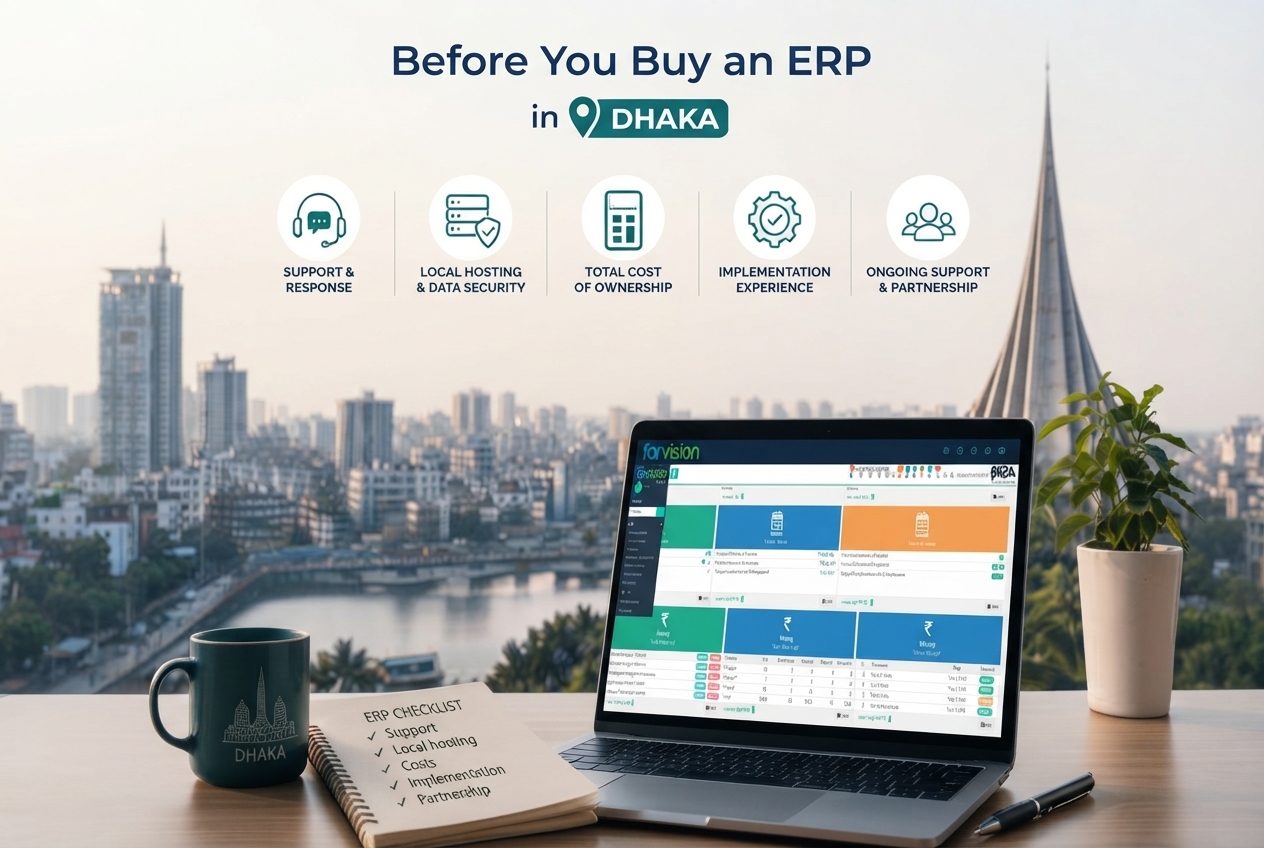
Buying an ERP in Dhaka can feel like a straightforward software decision until you are a few weeks into implementation and realize the real product you purchased was not just features. It was support quality, hosting reliability, and a cost structure that either stays predictable or slowly expands with every “small” request.
If you are currently shortlisting an ERP in Dhaka, this article is written for that exact moment, right before you sign. Because in Bangladesh, ERP success often depends less on the brochure and more on what happens after go-live: who picks up the phone, where your data lives, how upgrades work, and how much you will realistically spend across the first 12 to 24 months.
To make this practical, here are five questions we recommend asking any vendor before you commit to an ERP in Dhaka, especially if you are comparing ERP software Bangladesh options across cloud, on-premises, or hybrid.
Why These Questions Matter More Than Another Feature List
Most ERP sales conversations are designed to impress you with modules: Finance, HRMS, CRM, Inventory, POS, Manufacturing, WMS, MRP, and so on. Modules matter, of course. But in real life, two systems with similar modules can produce completely different outcomes based on support and delivery.
In Dhaka, where businesses often operate with tight timelines and constant operational pressure, you want an ERP partner that can keep up. A vendor can call themselves the best ERP software in Bangladesh, but your team will judge them on response times, training quality, documentation, and how cleanly the system adapts to your approvals, roles, and workflows.
That is why the next five questions are not “nice-to-ask.” They are the questions that protect your ROI when choosing an ERP in Dhaka. For instance, understanding the solutions offered by different vendors can significantly impact your decision-making process. Additionally, it’s crucial to consider factors such as support quality, hosting reliability and other aspects that influence the overall ownership experience of the ERP system.
1) What Does Support Actually Look Like After Go-Live?
This is the first question because it affects everything else. Many companies buy an ERP in Dhaka thinking implementation is the hard part. In reality, go-live is just the start of the relationship.
Ask the vendor to define support in writing, in plain language. Not “we provide 24/7 support” as a line in a PDF, but details that help you predict outcomes during a real incident.
You want to know who will support you. Is it the same implementation team, a separate helpdesk, or a rotating pool of agents? Will you get a dedicated account manager or escalation contact? How do they handle urgent outages versus non-urgent improvements?
Also ask about their experience in your industry. Support for a trading business is very different from ERP for manufacturing Bangladesh, and it is dramatically different for factories that depend on production planning, batch tracking, BOM, QC, and dispatch.
Here are a few support specifics worth checking for your ERP in Dhaka selection:
- SLA response time for critical issues, and real resolution benchmarks
- Support channels: phone, WhatsApp, ticketing, on-site visits
- Training plan for end users and admins, plus refresher training availability
- Post-go-live hypercare period, and what changes when hypercare ends
If you are considering garments ERP software Bangladesh options, ask how they handle seasonal peaks, line planning changes, buyer compliance reporting, and urgent production floor exceptions. A “standard support” model often collapses under real garments pressure.
2) Where Will Your Data Be Hosted, And What Does “Local” Really Mean?
When someone says “cloud,” ask: whose cloud, which region, and what controls do we get?
For many businesses buying an ERP in Dhaka, local hosting is not just a preference. It can be tied to compliance, latency, data sovereignty comfort, audit readiness, and operational continuity. This is why you should push past the generic label of cloud ERP Bangladesh and ask for specifics.
If the vendor offers local hosting, clarify whether it is a true local data center in Bangladesh, a regional setup, or simply a server that is “managed locally” but hosted elsewhere. Then talk about backup policies, disaster recovery, and data export procedures.
If you are choosing on-premises, ask what the vendor will and will not manage. You do not want surprises like “we support the ERP software, but your server is your problem” after you already committed.
A good vendor for ERP in Dhaka should be able to clearly explain:
How backups happen, how often, where they are stored, and how quickly data can be restored. Also ask about encryption, audit logs, and role-based access. Your ERP contains payroll, bank details, purchase pricing, customer receivables, supplier payables, and production costs. Security is not optional.
This question becomes even more important if you are adopting warehouse management software Bangladesh features like barcode scanning, QR, and real-time stock movements. WMS needs stable connectivity and predictable performance.
Moreover, understanding the local data hosting landscape is crucial. For instance, the Ministry of ICT in Bangladesh provides insights into the regulations and standards that govern local data hosting. This knowledge can empower businesses to make informed decisions when selecting their ERP and WMS vendors.
3) What Is The Real Cost Over 12 To 24 Months (Not Just The License)?
In Bangladesh, the biggest misunderstanding around ERP software price in Bangladesh is that buyers focus on the initial quote rather than the full operational cost. The license is only one piece of the puzzle.
To understand your real cost of an ERP in Dhaka, ask the vendor to break pricing into a simple, auditable structure. At minimum, you want to see: license or subscription, implementation, customization, integrations, training, support, hosting, and future upgrades.
The phrase to pay attention to is ERP implementation cost Bangladesh. That is where budgets often drift, not because vendors are always unfair, but because scope is rarely defined in enough detail early on.
If you hear “customization” too quickly, ask why. A strong ERP should handle many workflows using configuration, role-based approvals, and zero-code workflow builders. Custom code is sometimes necessary, but it should be the exception, not the business model.
Also ask about scale pricing. When your business grows from 30 users to 80 users, what changes? If you add a new branch, a new warehouse, or new POS counters, how does the bill change? If you want mobile access for sales reps, is that included?
When comparing ERP software for SME Bangladesh to enterprise-grade systems, the goal is not only affordability. It is predictability. Your CFO should be able to forecast ERP spend without fear of hidden “add-ons” every quarter.
4) How Will Integrations Work With Tally, SAP, QuickBooks, Or Existing Tools?
Most companies in Dhaka already run on a stack of tools, not a single platform. Even if you buy an ERP in Dhaka, you may still need integrations with accounting software, HR tools, attendance devices, e-commerce platforms, bank statement formats, or legacy databases.
So ask the vendor what integrations they have done before, and how they implement them. “We can integrate” is not the same as “we have stable connectors and we know the failure points.”
If you are migrating from Tally or maintaining parallel reporting in SAP, ask for a clear data flow plan. Integration is not only about connecting systems. It is also about ownership. Who monitors the integration? Who fixes it when it breaks? How are logs handled? What happens when an external tool updates its API?
For companies focused on inventory management software Bangladesh, integration questions get very specific. If stock comes in through imports, moves through multiple locations, and is sold through POS and B2B invoicing, you need consistency across items, units, batches, serials, and valuation methods. A weak integration strategy will silently corrupt reports.
Also ask about data migration. How will they migrate customers, suppliers, items, opening balances, historical transactions, and production masters? Data migration is where many ERP in Dhaka projects suffer from delays because it is underestimated.
5) Can The ERP Scale With Manufacturing, Warehousing, Retail, And Multi-Company Growth?
Many businesses start by buying an ERP in Dhaka for finance and inventory. Then reality hits. Sales teams want CRM. HR wants HRMS. Management wants dashboards. Manufacturing wants MRP. Warehouses want WMS. Retail wants POS. And leadership wants everything visible in one place.
So your key question is: can you start small without painting yourself into a corner?
This is where modular systems shine, especially for companies that want to begin with Finance, HRMS, CRM, Inventory, or POS, and later expand to full enterprise coverage. If you are evaluating a vendor that claims they are among the top 10 erp software in Bangladesh, ask them to show how modular scaling works in pricing, licensing, and deployment.
For manufacturing-heavy businesses, push deeper. If you need manufacturing ERP software Bangladesh, ask whether the system handles BOM versions, production orders, material requisitions, wastage tracking, machine-wise or line-wise outputs, and QA checkpoints. If you are in garments, ask how it handles style/variant complexity and multi-stage production flows. The phrase best garments erp software in Bangladesh gets used a lot. Your job is to validate it with workflows, not marketing.
For warehousing, ask about handheld devices, barcode scanning, bin locations, pick-pack-ship, cycle counts, and real-time stock visibility. A true warehouse management software Bangladesh capability is more than a stock ledger. It is operational control.
Finally, ask about multi-branch and multi-company. Many Dhaka businesses expand into Chattogram, Narayanganj, Gazipur, or export-focused units. Your ERP in Dhaka should support multi-location inventory, inter-branch transfers, consolidated financials, and role-based approvals without forcing you into a painful reimplementation.
A Quick Reality Check: How To Compare Vendors Without Getting Lost
If you are speaking to multiple vendors, you will hear a lot of similar claims. To keep it simple, bring the conversation back to three areas: proof, process, and people.
Proof means references. Ask for case studies in Bangladesh, ideally in your industry. Process means how they implement: discovery, documentation, configuration, testing, training, go-live, and post-go-live support. People means who will actually do the work, not just who sold the deal.
When you treat ERP selection this way, you will quickly see which ERP software company in Bangladesh is prepared for long-term delivery versus short-term selling.
And yes, we will say it again because it matters: choosing the right ERP in Dhaka is a support decision as much as it is a software decision.
Where Infoex Bangladesh Fits Into This Conversation
At Infoex Bangladesh, we simplify enterprise management through next-generation ERP software solutions that align technology with business goals. As a certified partner and distributor of Focus ERP, Farvision ERP, and Impact+ ERP systems, we work with organizations pursuing full digital transformation across finance, manufacturing, retail, and logistics.
For many businesses looking for an ERP in Dhaka, the appeal of a modular approach is simple: start with what you need today, then scale without rebuilding later. Focus 9, Focus X, Focus WMS, Focus MRP, and Focus POS are designed to work as a complete suite or as standalone modules. Many teams begin with Finance, HRMS, CRM, Inventory, or POS, then expand into manufacturing, warehousing, and multi-branch operations.
We also see integration as a real-world requirement, not a nice-to-have. Strong integration capability with tools like Tally, SAP, and QuickBooks, plus customization options, zero-code workflow creation, role-based approvals, granular security, real-time dashboards, mobile access, and barcode/QR support can make an ERP rollout feel practical instead of disruptive. This is especially important for growing manufacturing operations and companies evaluating ERP for manufacturing Bangladesh or garments ERP software Bangladesh options.
If you are comparing cloud ERP Bangladesh versus on-premises versus hybrid, we also recommend deciding based on operational reality: connectivity, compliance comfort, IT capacity, and how quickly you need to scale.
FAQs
What Is The Fastest Way To Evaluate ERP In Dhaka Without Wasting Weeks?
Ask for an ERP demo Bangladesh session using your own workflows: purchasing, sales, inventory, approvals, and reports. A vendor who can map real processes quickly is usually implementation-ready.
How Do We Estimate ERP Implementation Cost Bangladesh More Accurately?
Insist on a written scope with modules, users, integrations, data migration, training, and support terms. Clear scope reduces surprises and makes ERP implementation cost Bangladesh far easier to control.
Is Cloud ERP Bangladesh Always Better Than On-Premises?
Not always. Cloud is great for speed and scale, but on-premises can suit strict control needs. Choose based on latency, compliance comfort, IT capacity, and disaster recovery expectations.
Which ERP Software Bangladesh Works Best For Manufacturing And Garments?
Look for strong MRP, WMS, batch/serial tracking, BOM control, and production reporting. For garments, validate style and variant complexity. Do not trust “best” claims without real demos.
What Should We Check In ERP Software Price In Bangladesh Quotes?
Check what is included: licenses, hosting, implementation, customization, integrations, training, support, and upgrades. Compare 12 to 24-month total cost, not only the first invoice.
Get Started With Infoex Bangladesh
If you are about to buy an ERP in Dhaka, please do not sign based only on a module checklist and a discount. We have seen too many teams end up with a system that looks great in a proposal but struggles in support, hosting clarity, and long-term cost control.
At Infoex Bangladesh, we would rather help you ask the right questions first, then recommend the right-fit approach, whether you need finance and inventory today or a full roadmap covering WMS, MRP, POS, and multi-branch growth tomorrow. If you want, we can walk you through a practical ERP demo Bangladesh session, share realistic costing, and help you compare options without confusion.