




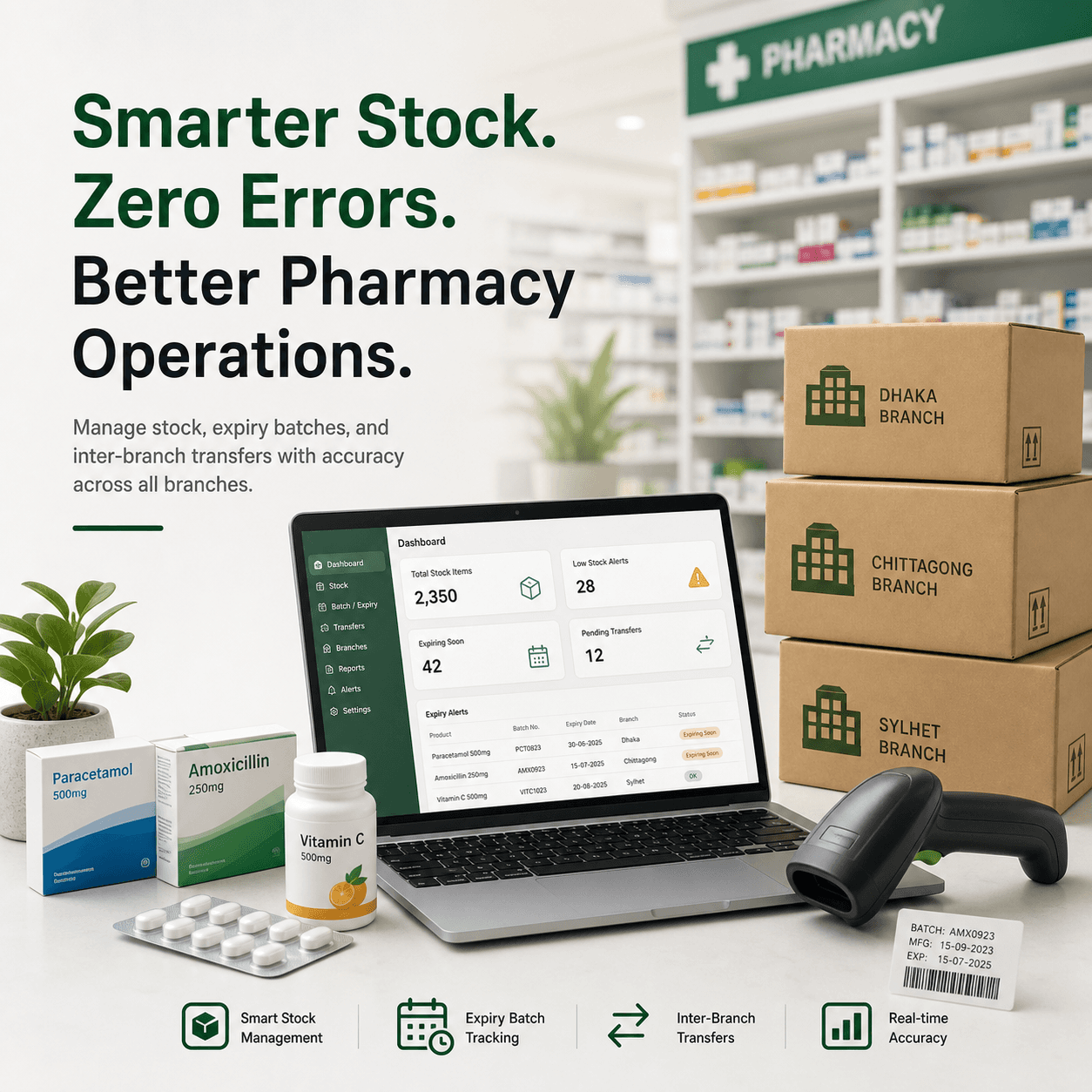
Running a pharmacy chain is one of those businesses where “almost correct” still equals wrong. If the stock figure is off by 2 strips, if an expiry batch slips into a sale, or if an inter-branch transfer gets recorded late, you end up paying for it in cash, compliance risk, and customer trust. That is exactly why more operators are moving to a modern Pharmacy ERP that tracks inventory in real time, controls batches properly, and keeps every branch working off one source of truth. In Bangladesh, a modern Pharmacy ERP is no longer a “nice to have”; it is the foundation for accuracy across purchasing, POS, stock movement, and reporting.
In this guide, we will break down the real reasons pharmacy inventory goes inaccurate, then show how a well-configured Pharmacy ERP solves it with batch-level tracking, expiry controls, barcode workflows, and clean inter-branch transfers. We will also share what to look for when evaluating options in the context of ERP software Bangladesh, including deployment choices like cloud ERP Bangladesh and practical expectations around ERP implementation cost Bangladesh.
Why Pharmacy Inventory Accuracy Breaks Down In Real Life
Most pharmacy chains do not suffer from one big mistake. They suffer from many small ones that compound. A purchase entry is rushed. A salesperson overrides a warning. A transfer is shipped but not received in the system. A return is physically placed back on shelf but not posted correctly. Then month-end comes, and the “actual stock” and the “system stock” do not even look related.
Here are the repeat offenders we see most often in Bangladesh:
- Batch numbers not captured at receipt, so expiry cannot be controlled properly later.
- Multiple branches using separate systems or spreadsheets, causing timing gaps and duplicate SKUs.
- Sales happening while goods receipt is pending, creating negative stock or hidden stock-outs.
- Inter-branch transfers treated like informal courier movements rather than documented stock transactions.
- Returns and damages handled physically, but not reflected in accounting and inventory ledgers.
- No barcode discipline, so staff rely on memory, shelf labels, or manual item search.
A capable Pharmacy ERP fixes these root causes by forcing clean data capture at the right moment and by tying inventory movement to approvals, user roles, and auditable stock ledgers.
The Core Inventory Setup A Pharmacy ERP Must Have

If you want accurate stock across multiple outlets, your setup matters as much as the software. The right Pharmacy ERP should support a structure where each branch is a location with its own store and stock ledger, while still rolling up to head-office reporting.
At minimum, you want product masters that are consistent across all outlets. That includes item names, strengths, forms (tablet, syrup, injection), pack sizes, purchase units vs sales units, VAT rules, and supplier mappings. This sounds basic, but inconsistent master data is a silent killer in multi-branch operations.
In Bangladesh, many pharmacy groups also run a small warehouse or central store for bulk procurement. In that case, choosing a Pharmacy ERP that can handle a warehouse-first model is crucial, and it helps to look for systems that overlap with warehouse management software Bangladesh capabilities like bin location, pick/pack workflows, and barcode scanning.
Batch And Expiry Control: Where Most Pharmacies Lose Money
Expiry management is not a report. It is a daily process. Pharmacies that treat it like a monthly Excel exercise usually discover expired stock when it is too late to return, too late to discount, and too late to avoid customer risk.
A proper Pharmacy ERP should support batch-wise inventory at every step:
When you receive goods, the GRN should capture batch number, manufacturing date (if needed), and expiry date. From that moment, every movement should preserve batch identity: transfer, sale, return, and adjustment. That is the only way FIFO or FEFO policies can actually work in the real world.
In practice, you want three capabilities that make expiry control “automatic” rather than dependent on staff memory.
First, the system should enforce FEFO (First Expiry First Out) at POS, or at least recommend the nearest expiry batch. Second, it should block sales of expired batches and optionally warn for “near-expiry” items based on a defined threshold (for example, 60/90/120 days). Third, it should generate actionable alerts, not just lists: what to move, what to discount, what to return to vendor, and what to quarantine.
This is where a modern Pharmacy ERP with dashboards and alerts becomes a daily operational tool instead of an afterthought. Solutions that come under the umbrella of strong inventory management software Bangladesh typically do well here, but only if batch tracking is truly end-to-end.
POS Accuracy: The Checkout Is Where Stock Gets Corrupted
In many chains, the POS counter is the highest-traffic point and the least controlled point. That combination creates chaos. If cashiers can sell without batch selection, override negative stock, or bypass barcode scanning, your system will always drift away from reality.
A well-designed Pharmacy ERP POS flow should make the “correct way” the “easy way.” Barcode scanning should pull the exact SKU and, ideally, help select the right batch. If the outlet is busy, the POS should still be fast while enforcing rules quietly in the background.
You also want permissions. Not everyone should be able to edit item prices, change tax rules, or override expiry warnings. This is where role-based security and approvals matter, and it is one reason many growing chains evaluate an enterprise-grade Pharmacy ERP rather than a basic shop software.
If you are comparing options in ERP software Bangladesh, ask this one question: “Can the POS enforce batch and expiry behavior without slowing us down?” If the answer is vague, accuracy will be vague too.
Inter-Branch Transfers: Make Them Two-Step Or They Will Always Be Wrong

Transfers are where multi-branch accuracy usually collapses, because businesses treat transfers like a courier event instead of an accounting event. Stock leaves Branch A physically, but in the system, it leaves late or not at all. Branch B receives it physically, but “forgets” to post receipt. Or worse, Branch B sells it before the transfer is posted, creating negative stock confusion and audit nightmares.
A reliable Pharmacy ERP should support a two-step transfer workflow:
Branch A creates an Inter-Branch Transfer (IBT) outward document that reserves or reduces stock, with batch-level details. Then Branch B confirms receipt against that IBT, and only then does stock become available for sale in Branch B. If there is shortage, damage, or mismatch, the receipt should capture that difference with reason codes and approvals.
This two-step approach creates a clean in-transit state. It also gives head office visibility: what is pending, what is delayed, and where stock is stuck. If you are also running a central warehouse, this becomes even more important, and you will benefit from a Pharmacy ERP that can work with warehouse workflows similar to warehouse management software Bangladesh.
Returns, Damages, And Recalls: The Hidden Inventory Leaks
Pharmacies often handle returns and damages with “common sense,” but common sense does not create accurate ledgers. If a customer returns a strip, you need to know: was it sold from which batch, is it saleable, does it go to quarantine, and what is the financial impact?
A strong Pharmacy ERP should support separate statuses and locations, such as Saleable, Quarantine, Damaged, and Returned to Vendor. That way, you do not mix bad stock with good stock and inflate your available quantity.
For recalls, batch traceability becomes critical. If you ever need to identify which branches have batch X of item Y, and how many units are still unsold, you cannot do it reliably without batch-wise tracking. This is another area where Pharmacy ERP pays for itself by reducing risk exposure.
Real-Time Reporting: Stop Waiting For Month-End To Discover Problems
The biggest mental shift is moving from “monthly stock reconciliation” to “daily exception management.” Instead of counting everything, you fix what is abnormal.
A well-implemented Pharmacy ERP should give you real-time dashboards like:
Fast-moving items by outlet, stock-out risks, near-expiry value, pending transfers, negative stock exceptions, and margin leakage by item category. With AI-driven insights (in systems that support it), you can also spot unusual patterns like sudden shrinkage, repeated overrides, or abnormal discounting.
This is where enterprise systems stand out compared to lighter tools. If you are evaluating the best ERP software in Bangladesh, make sure reporting is not just a list of static reports, but a management layer you can actually use daily.
Deployment Choices In Bangladesh: Cloud, On-Premises, Or Hybrid
For many pharmacy chains, the decision is not purely technical. It is about reliability, cost, and control. Cloud ERP Bangladesh deployments are popular because they reduce server maintenance and make it easier to roll out new branches. On-premises can still make sense for groups that want full internal control, have stable IT support, or operate in areas with inconsistent internet.
A modular Pharmacy ERP that offers cloud, on-premises, or hybrid deployment gives you flexibility. For example, some chains prefer cloud for head office and reporting, while outlets run lightweight local operations with sync options depending on connectivity. The key is not the label. The key is whether the system maintains data integrity across branches without creating duplicates or sync conflicts.
Where Infoex Bangladesh Fits In (And Why Modularity Matters)
At Infoex Bangladesh, we focus on simplifying enterprise management with modern ERP solutions aligned with business goals. As a certified partner and distributor of Focus ERP, Farvision ERP, and Impact+ ERP systems, we help organizations move toward end-to-end digital transformation across finance, inventory, retail, and logistics.
For pharmacy chains specifically, modularity is often the difference between “we can start now” and “we will do it later.” With Focus solutions such as Focus 9, Focus X, Focus WMS, Focus MRP, and Focus POS, you can begin with the essentials of a Pharmacy ERP like Inventory and POS, then scale into Finance, HRMS, CRM, approvals, and advanced warehouse processes as you grow. The ability to expand without replacing the system is a major advantage for multi-branch operators in Bangladesh.
If you are searching for an ERP software company in Bangladesh that can handle multi-outlet complexity, integrations, security, and rollout support, it is worth prioritizing vendors who can demonstrate real workflows, not just slides. That is why requesting an ERP demo Bangladesh is such a practical step before committing.
Integrations And Controls That Protect Accuracy
Accuracy is not only about inventory screens. It is also about what connects to inventory. If your accounting system is separate, if your procurement approvals are on paper, or if your POS discounts are uncontrolled, inventory will suffer.
Look for a Pharmacy ERP that can integrate with tools businesses already use, including platforms such as Tally, SAP, and QuickBooks where relevant, and that supports configurable approvals and role-based permissions. Zero-code workflow creation also matters more than people expect. It lets you enforce rules like purchase approvals, transfer approvals, and stock adjustment approvals without waiting on custom development.
In the Bangladesh market, buyers often compare lists like the top 10 erp software in Bangladesh, but the real differentiator is whether the system can be shaped around your process while maintaining strict audit trails.
A Practical Implementation Path For Pharmacy Chains

A common reason ERP projects fail is trying to do everything at once. A better approach is rolling out in phases, while keeping data clean and training consistent.
Start by standardizing your item master and supplier list, then configure branches, warehouses, and pricing rules. Next, turn on batch and expiry controls and make sure the POS flow supports them. After that, implement inter-branch transfer workflows and central procurement logic. Finally, stabilize reporting and exception dashboards so management can monitor daily.
As you plan, you will naturally ask about ERP software price in Bangladesh and ERP implementation cost Bangladesh. Pricing typically depends on modules, number of users, branches, deployment type, and the level of customization and integrations needed. The lowest quote is rarely the lowest total cost if it leads to weak controls or repeated manual work.
If you are an SME pharmacy group, you may also want to compare options marketed as ERP software for SME Bangladesh. Just make sure “SME-friendly” does not mean “no batch tracking,” because that is non-negotiable for pharmacies. A true Pharmacy ERP keeps the essentials strong even if you start small.
In addition to these factors, it’s crucial to consider the security of your manufacturing environments as well. Implementing robust security measures such as those offered by Oracle Access Governance can help protect sensitive data and ensure compliance with industry regulations.
What About Manufacturing ERP Keywords And Why They Still Matter Here?
You might notice categories like ERP for manufacturing Bangladesh, manufacturing ERP software Bangladesh, garments ERP software Bangladesh, and even best garments erp software in Bangladesh in the ERP market. While those sound unrelated, the underlying strengths often overlap: batch tracking, lot traceability, warehouse control, approvals, and multi-location inventory. A system that performs well in complex manufacturing environments can also perform well in pharmacy distribution and multi-branch stock control, provided the POS and pharmacy workflows are configured properly.
That is also why modules like WMS and MRP, while not always required for a retail pharmacy, can become valuable if you run a central distribution warehouse or do repacking, kitting, or large-scale procurement planning.
The Non-Negotiables Checklist Before You Choose A Pharmacy ERP
Before you commit, make sure your shortlisted Pharmacy ERP can handle the fundamentals without workarounds. You do not need hundreds of features. You need the right few features done correctly, with clean auditability and speed at the counter.
A pharmacy-ready system should support batch-wise inventory, expiry alerts, FEFO/FIFO options, barcode and QR workflows, two-step inter-branch transfers, controlled stock adjustments, and real-time reporting across branches. If it cannot do these well, it is not a real Pharmacy ERP, even if it is marketed as “ERP.”
FAQs
What Is The Fastest Way To Reduce Stock Mismatch Across Branches?
Standardize item masters, enforce barcode scanning at POS, and run all branches on a single Pharmacy ERP with two-step inter-branch transfers. This removes timing gaps and manual posting errors.
How Does A Pharmacy ERP Help With Expiry Management?
A Pharmacy ERP tracks stock by batch and expiry, applies FEFO at sales, blocks expired items, and creates near-expiry alerts. That makes expiry control a daily workflow, not a monthly report.
Is Cloud ERP Bangladesh A Good Fit For Pharmacy Chains?
Often yes. Cloud ERP Bangladesh deployments simplify multi-branch rollout, reduce server maintenance, and provide real-time visibility. The key is reliable connectivity planning and role-based security for sensitive operations.
What Should We Ask For In An ERP Demo Bangladesh Session?
Ask to see live workflows: GRN with batch/expiry entry, POS batch selection, expiry warnings, two-step inter-branch transfer, returns to quarantine, and dashboards. A real ERP demo Bangladesh should prove accuracy controls.
How Do We Estimate ERP Implementation Cost Bangladesh For Pharmacies?
ERP implementation cost Bangladesh depends on branches, users, modules, data migration, integrations, and training. A true Pharmacy ERP budget should include process design and controls, not just software licensing.
Get Started With Infoex Bangladesh
If you are tired of reconciling spreadsheets, chasing transfer notes, and discovering expired stock too late, it is time to upgrade the way your chain runs. At Infoex Bangladesh, we help pharmacy businesses implement a practical, scalable Pharmacy ERP using proven ERP platforms and a rollout approach built around real operations, not theory. If you want a clear plan, transparent expectations on ERP software price in Bangladesh, and a hands-on walkthrough, we are ready to arrange your ERP demo Bangladesh and map the quickest path to clean stock, controlled expiry, and reliable inter-branch transfers.



The two-step transfer point is spot on — so many pharmacy chains treat transfers like a courier drop instead of an actual stock transaction, and that’s exactly where the “system stock vs actual stock” gap starts. Once branch B starts selling before confirming receipt, you’re basically guessing after that.
Batch-level FEFO enforcement at POS is the other one that gets skipped a lot, usually because it slows cashiers down slightly. But the alternative (manual memory-based FIFO) is how expired stock ends up on shelves in the first place.