



If you run a factory or manage operations in apparel, you already know the pressure is different here. Tight lead times, buyer compliance, constant style changes, pricing pressure, and the daily reality of coordinating merchandising, production, inventory, and accounts without mistakes. That is exactly why garment ERP software in Bangladesh has become less of a “nice-to-have” and more of a survival tool in 2026.
In this guide, I will walk you through what “best” really means when choosing garment ERP software in Bangladesh, what modules matter most, what to expect on pricing and rollout, and which ERP options are actually realistic for Bangladeshi garments businesses of different sizes. Along the way, I will also share a practical perspective from what we see in the market through Infoex Bangladesh, where we help companies implement ERP across finance, manufacturing, retail, and logistics.
Why Garment ERP Matters More In 2026 (Not Just “Automation”)
In 2026, ERP is not only about replacing spreadsheets. Buyers expect faster sampling cycles, stricter traceability, and cleaner documentation. Management expects real-time profitability, not month-end surprises. Production teams need fewer manual handoffs because every delay snowballs into air shipments and penalties.
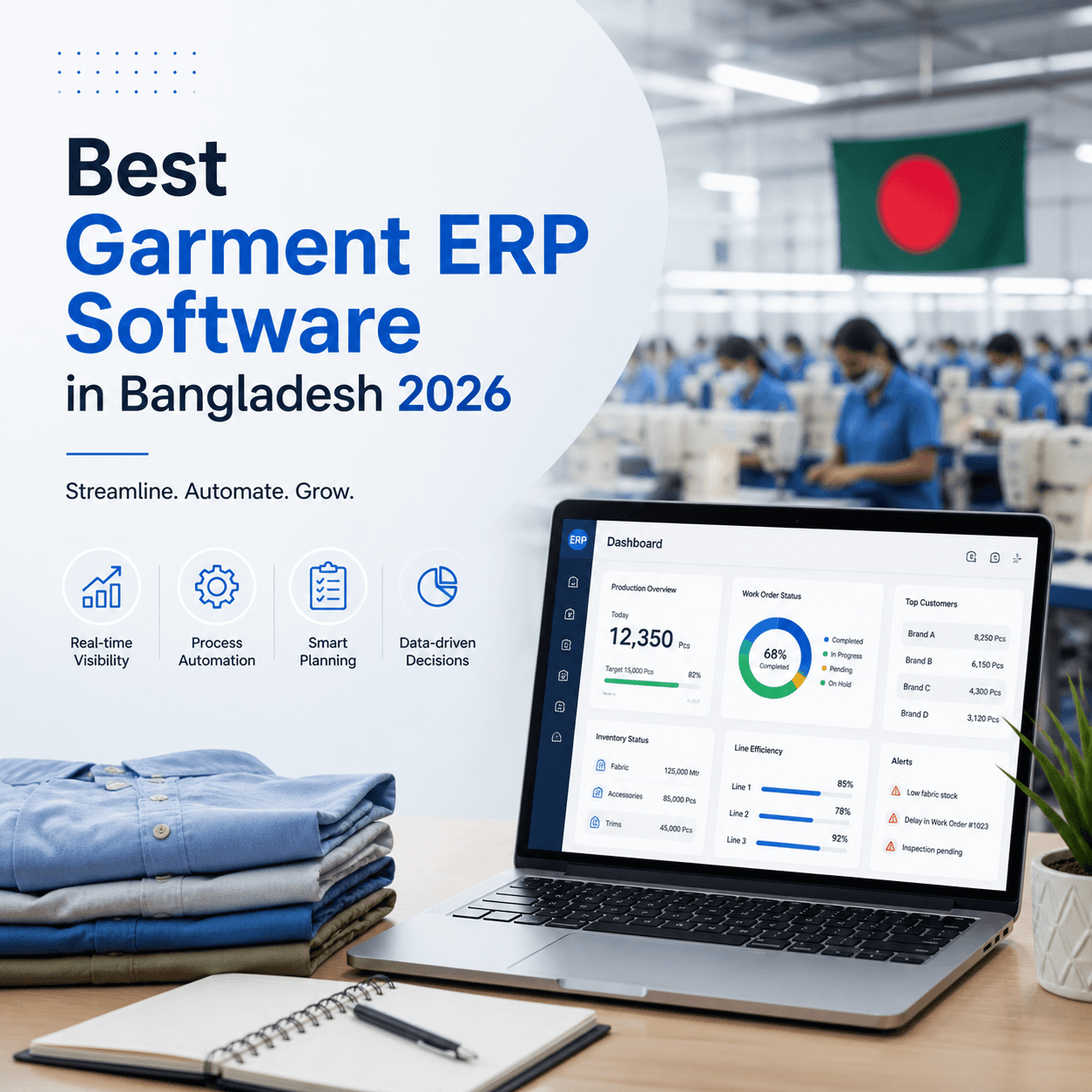
That is why garment ERP software in Bangladesh is increasingly purchased for three outcomes: visibility, control, and speed. When implemented properly, garments ERP software Bangladesh connects merchandising to BOM, BOM to procurement, procurement to inventory, inventory to production, production to QC, and QC to shipment while finance tracks everything automatically.
A good ERP also reduces the “hidden costs” that do not show up in one department: wrong trims, duplicate purchase orders, unplanned overtime, poor line loading, lost stock, and unclear WIP. In practical terms, the best teams use ERP for manufacturing Bangladesh to create one shared source of truth so every department stops working from separate versions of reality.
What “Best Garment ERP Software” Actually Means In Bangladesh
When people search for the best garments erp software in Bangladesh, they often assume there is one “#1” for every factory. In reality, the best choice depends on your product category (knit, woven, sweater, lingerie), your order complexity, your compliance needs, and how mature your processes are today.
Still, the best garment ERP software in Bangladesh usually shares a few traits. It supports multi-company and multi-location operations, handles production planning and WIP properly, tracks inventory by lot or batch when needed, and gives management dashboards that match how garments businesses make decisions.
It should also be flexible in deployment. Many groups want cloud ERP Bangladesh for speed and scalability, while others want on-premises for internal policy reasons. In 2026, a hybrid approach is also common: cloud access for management and remote teams, with controlled local infrastructure for certain plants.
The Core Modules You Should Not Skip (Garments Edition)
A garments business can run on partial modules at first, but some areas are too interconnected to treat casually. For most factories, the strongest garment ERP software in Bangladesh focuses on these foundations.
First is finance. Without clean finance integration, production data never turns into profitability insights. Second is inventory and stores. If your stock accuracy is weak, planning becomes guesswork. Third is production planning and WIP. That is where delays and hidden waste live.
Then you layer merchandising, procurement, HR/payroll, quality, and commercial (export documentation) depending on your business model. If you run a warehouse-heavy operation, warehouse management software Bangladesh features become very important, especially barcode and bin-level control.
Here are the modules most buyers in 2026 typically prioritize for garment ERP software in Bangladesh:
- Finance and Costing (with factory-wise profitability)
- Inventory Management Software Bangladesh (raw materials, trims, finished goods)
- Manufacturing and Production (line planning, WIP, output, wastage)
- Procurement and Supplier Management
- Warehouse Management Software Bangladesh (barcode/QR, locations, picking)
- HRMS and Payroll (attendance, OT, compliance)
- CRM / Order Management (merchandising workflows and approvals)
Focus ERP In 2026: A Practical Fit For Growing Garments Manufacturers
In Bangladesh, one of the most practical ERP families for garments and broader manufacturing use is Focus. At Infoex Bangladesh, we work as a certified partner and distributor for Focus ERP solutions, and what stands out in 2026 is how modular and scalable the ecosystem is.
Focus solutions like Focus 9, Focus X, Focus WMS, Focus MRP, and Focus POS can be deployed as a complete suite or as standalone modules. That matters because many companies want to start small and expand. For example, you might begin with Finance + Inventory, then add MRP, WMS, HRMS, and approvals once teams are comfortable.
This modular approach is especially relevant for ERP software for SME Bangladesh buyers, as well as mid-sized garment groups trying to standardize multiple units gradually. And because garments operations can be complex, the ability to customize workflows without heavy development becomes a big advantage.
Why Modular ERP Wins In Bangladesh (And Why It Reduces Risk)
A common fear with ERP is disruption. People imagine a “big bang” go-live, huge training needs, and chaos. Modular ERP reduces that risk. Instead of forcing every department to switch overnight, you can phase the implementation.
This is one reason modern buyers gravitate toward ERP software Bangladesh options that support step-by-step adoption. For example, you can implement Finance first, then Inventory, then Production, then advanced planning and warehouse barcode. If you are searching for garment ERP software in Bangladesh that does not overwhelm your teams, modular rollout is often the smartest path.
Focus ERP also supports cloud, on-premises, and hybrid deployments. That flexibility matters in Bangladesh, where connectivity, compliance requirements, and IT policy vary a lot by group.
Integration And Automation: Where ERP Actually Saves Money
In 2026, the best ERP projects are not only about recording transactions. They reduce manual work through integrations and approvals.
Focus offers integration capabilities with tools like Tally, SAP, and QuickBooks. In real operations, this helps groups that have legacy accounting or need data exchange with partners. The system also supports zero-code workflow creation, role-based approvals, and granular security. That means you can set up approvals for purchase requests, PO releases, stock transfers, production issues, and payments, without building a custom app from scratch.
When garment ERP software in Bangladesh includes real workflow automation, you get fewer delays from “missing approvals,” fewer disputed numbers, and better audit trails.
Garments Manufacturing Features That Matter Most (WIP, MRP, And Traceability)
A generic ERP can handle accounting and stock. The question is whether it can handle garments reality: fast-changing styles, multiple sizes and colors, complex BOM changes, and frequent buyer-driven revisions.
A strong manufacturing ERP software Bangladesh setup should help you track WIP at the right granularity, plan materials through MRP, and forecast what is missing before the line stops. Focus MRP, paired with inventory and production modules, can support more structured planning and reduces the “firefighting” culture.
Traceability is also growing in importance. Barcode/QR generation and scanning, mobile access for supervisors, and real-time dashboards are now expected features, not luxuries. When you evaluate garment ERP software in Bangladesh, ask to see live WIP tracking and how quickly management can spot bottlenecks.
Cloud ERP Vs On-Premises In Bangladesh: What To Choose In 2026?
Both models can work, but the “best” depends on your operational constraints.
Cloud ERP Bangladesh is often chosen for faster deployment, lower upfront infrastructure costs, and easier access for owners and remote teams. It also supports quick scaling when you add new units.
On-premises is preferred by some large groups who want full internal control, have strong IT teams, and follow strict policies. Hybrid is increasingly popular because it balances control with convenience.
When you shortlist garment ERP software in Bangladesh, do not treat deployment as an afterthought. It impacts cost, speed, security, and even user adoption.
ERP Software Price In Bangladesh: What You Should Expect (And What People Forget)
Let us talk about budget realistically, because ERP software price in Bangladesh is a top decision factor. Most companies think only in terms of license cost. In real life, total cost includes implementation, training, data migration, customization, integrations, and post-go-live support.
So instead of asking only “What is the ERP price?”, ask two better questions:
- What is the total ownership cost over 3 years?
- What is the ERP implementation cost Bangladesh for my exact scope and rollout plan?
Costs vary based on module count, number of users, number of factories/locations, and the complexity of approvals and reporting. A phased rollout often reduces risk and spreads cost across quarters.
If you are comparing options for best ERP software in Bangladesh, insist on a transparent scope-based estimate, not a vague package price.
ERP Implementation In Garments: What A Good Rollout Looks Like
Implementation is where most ERP projects either succeed or fail. The best vendors do not just “install software.” They map your processes, help clean master data, train users properly, and stay close during the first production cycle.
In garments, a practical rollout usually starts with a pilot unit or a limited scope, then expands. It also includes clear sign-offs for master data like items, BOMs, suppliers, customers, and chart of accounts.
If you are evaluating an ERP software company in Bangladesh, ask how they handle change management. Many ERP failures are not technical. They happen because teams were not trained, departments did not agree on process ownership, or old shortcuts were not replaced with new habits.
How To Shortlist The Best Options (Without Getting Tricked By Marketing)
If you search “top 10 erp software in Bangladesh” you will see many lists. Some are helpful, many are generic. Your shortlist should be based on your garments workflow, not brand popularity.
Here is a practical way to filter. Ask for an ERP demo Bangladesh session that uses your own sample data: one style, one BOM, one PO cycle, one production run, one shipment. Then watch how many steps it takes, and whether the output reports match what management needs.
Also test the quality of mobile access, dashboards, and security roles. For garment ERP software in Bangladesh, role-based approvals and granular permissions are not optional, because internal controls matter when multiple departments touch the same transactions.
Why Focus ERP Is Often Selected For Manufacturing In Bangladesh
In 2026, Focus continues to be chosen for many manufacturing-heavy businesses because it is modular, scalable, and customizable without excessive development. It supports single companies and large multi-country groups, which is relevant for Bangladeshi exporters expanding abroad.
Its real-time dashboards, AI-driven insights, mobile access, and workflow approvals are especially useful when leadership wants visibility without waiting for manual reports. Add WMS features like barcode/QR and location-based picking, and it becomes a serious operational backbone for factories and warehouses.
For garments businesses looking for ERP for manufacturing Bangladesh, the key benefit is that you can start with a few modules and scale to a full enterprise system as your process maturity improves. That makes it a practical answer to the question: “Which garment ERP software in Bangladesh will still fit us three years from now?”
Choosing ERP For SME Vs Large Groups In Bangladesh
Small and mid-sized factories usually need fast wins: finance control, stock accuracy, faster approvals, and production visibility. They typically care about ease of use and speed of rollout. This is where ERP software for SME Bangladesh buyers benefit from modular ERP, because you do not have to purchase everything upfront.
Large groups often need multi-company consolidation, intercompany transactions, multi-location warehouse control, and stronger governance. They also want standardized reporting across units. In both cases, the best garment ERP software in Bangladesh is the one that fits your scale today while keeping the door open for growth.
Common Mistakes Buyers Make (So You Can Avoid Them)
A surprising number of teams choose ERP based on a beautiful demo, then discover gaps after go-live. The fix is simple: test the demo using your real garments workflow.
Another common issue is underestimating data cleanup. Bad item masters and messy BOMs will produce bad planning outputs, no matter how good the ERP is. Finally, do not ignore support and training. A system can be powerful, but if users cannot use it confidently, you will fall back to spreadsheets.
If your goal is to choose the best garments erp software in Bangladesh, prioritize implementation capability as much as software features.
Final Thoughts: Picking The Best Garment ERP Software In Bangladesh In 2026
In 2026, the “best” ERP is not the one with the longest feature list. It is the one your team will actually use daily, the one that gives management real visibility, and the one that scales as your factory grows.
If you are actively comparing garment ERP software in Bangladesh, focus on modularity, manufacturing depth, workflow automation, integration options, and the vendor’s ability to implement successfully. When those pieces align, ERP becomes a growth engine, not just a software purchase.
And yes, if you want one strong direction: Focus ERP’s modular suite, including Focus 9, Focus X, Focus WMS, Focus MRP, and Focus POS, is a practical option many Bangladeshi manufacturers consider because it supports phased adoption, deep customization, and flexible deployment.
Faqs
What Is The Best Way To Choose Garment ERP Software In Bangladesh In 2026?
Ask for an ERP demo with your real style, BOM, PO, production, and shipment flow. Then compare reporting, approvals, inventory accuracy tools, and implementation support, not just features.
How Much Does ERP Software Price In Bangladesh Usually Cost For Garments?
ERP software price in Bangladesh depends on users, modules, sites, and customization. Budget for licenses plus ERP implementation cost Bangladesh like training, data migration, integrations, and post-go-live support.
Is Cloud ERP Bangladesh A Good Fit For Garments Factories?
Cloud ERP Bangladesh is great for faster rollout and easier access across units. It works well when you need scalability and management visibility, and have stable connectivity and clear access control.
Which Modules Matter Most In Garment ERP Software In Bangladesh?
Start with finance, inventory management software Bangladesh, and production/WIP. Then add MRP, warehouse management software Bangladesh features, procurement, HRMS, and approvals as your process stabilizes.
Can ERP Software For SME Bangladesh Start Small And Scale Later?
Yes. Modular ERP lets SMEs begin with finance or inventory, then add manufacturing, WMS, HRMS, and dashboards later. This reduces risk while still building a scalable foundation.
Talk To Infoex Bangladesh
If you are serious about implementing garment ERP software in Bangladesh in 2026, we can help you avoid expensive wrong turns. At Infoex Bangladesh, we assess your workflow, recommend the right modules, show a realistic demo, and guide a phased rollout so your team adopts ERP with confidence. Reach out to us for an ERP demo Bangladesh and a clear scope-based estimate that fits your factory, your timeline, and your goals.