



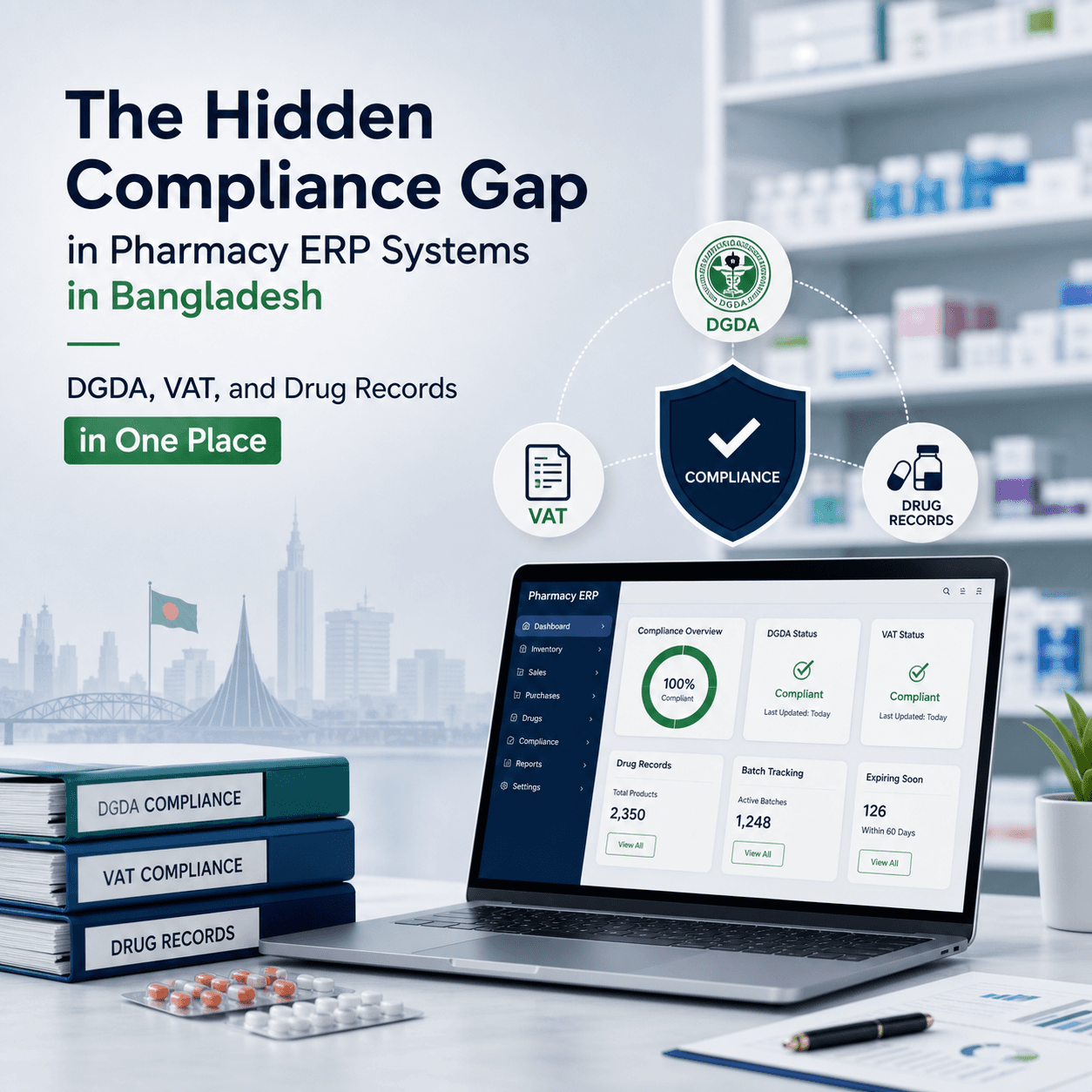
If you run a pharmacy business in Bangladesh, you probably already know this uncomfortable truth: compliance is rarely “one big thing.” It is a hundred small things that have to be right every single day. A sales invoice that needs the correct VAT logic, a batch record that must match reality, an expiry that should block billing, a purchase that needs proper documentation, and stock that must reconcile across shelves, warehouse, and system.This is exactly where the hidden gap shows up. Many businesses adopt an ERP, but not a Pharmacy ERP.
In this article, we will unpack the real compliance gap in Bangladesh and what a modern Pharmacy ERP should do to close it. Along the way, we will connect the dots between DGDA-style record readiness, VAT reporting accuracy, and drug batch and expiry control so your team can operate with less stress and fewer surprises.
Why Compliance Breaks Even When You Have An ERP

Most compliance issues are not caused by “no software.” They are caused by software that was not configured to behave like a pharmacy business. A generic trading ERP might capture purchases and sales, but a pharmacy needs tighter controls, more structured masters, and stronger traceability.
This is why the same pharmacy can have “computerized billing” and still struggle to answer simple questions like: Which batches were sold in the last 30 days? How many units of a controlled item were dispensed by counter and by shift? Which supplier invoices are tied to which batch lots? Are VAT and discounts being applied consistently across items?
A capable Pharmacy ERP closes this gap by enforcing disciplined data capture at the moment it matters: purchase entry, batch receiving, storage transfer, sales billing, returns, and expiry handling. It is less about “more features” and more about “fewer loopholes.”
The DGDA Reality: Record Readiness Is Not Optional

When people say “DGDA compliance,” they often imagine a single inspection day. In reality, compliance is daily operational hygiene. Whether you are a retail pharmacy, a wholesale distributor, or a growing chain, you need your records to be coherent, retrievable, and defensible.
A properly implemented Pharmacy ERP helps you stay record-ready by standardizing how product, batch, and transaction data is stored and connected. That matters because DGDA-related readiness often hinges on your ability to show consistent documentation, not just “a report you made yesterday.”
Here are common DGDA-facing record areas where businesses stumble:
- Purchase-to-stock linkage breaks (items received but not traceable to supplier invoices).
- Batch and expiry are maintained “somewhere else,” not enforced at billing.
- Returns and damages are handled outside the system.
- Controlled or sensitive products are not segregated in reporting and approvals.
A strong Pharmacy ERP makes these gaps harder to create by design, especially when you implement role-based approvals, compulsory batch entry, and audit trails.
VAT Compliance: The Silent Risk Sitting Inside Your Sales Screen
VAT problems usually don’t announce themselves. They accumulate quietly: a wrong item tax category here, an inconsistent discount treatment there, and suddenly your monthly reporting becomes a manual reconciliation project.
What makes VAT uniquely risky is that it touches both finance and operations. If your billing counter bypasses the correct tax logic, finance will spend days fixing it later. A capable Pharmacy ERP prevents that by building VAT logic into item masters, customer types, pricing rules, and invoice formats.
In Bangladesh, many businesses searching for ERP software Bangladesh discover that “VAT-ready” can mean anything from “you can export to Excel” to “it actually enforces correct VAT behavior.” The difference matters.
A Pharmacy ERP that is truly VAT-aligned should support:
- Consistent VAT calculation based on your configured rules.
- Audit-friendly invoice numbering and document control.
- Clean separation of taxable and non-taxable items if applicable.
- Reporting structures that reduce manual manipulation.
This is also where choosing the best ERP software in Bangladesh becomes less about brand popularity and more about implementation maturity. A tool is only as compliant as the rules and workflows you set inside it.
Drug Records: Batch, Expiry, And Traceability Must Live Together

In pharmacies, “inventory accuracy” is not just a cost topic. It is a compliance topic and a safety topic. Batch and expiry records cannot be optional fields that staff skip when they are busy.
A modern Pharmacy ERP must enforce batch and expiry entry at goods receiving and must carry that information through transfers, sales, returns, and adjustments. Otherwise, you end up with stock that exists financially but not physically, or physically but not traceable.
Here is what “good” looks like operationally:
Purchase receiving creates stock lines by batch and expiry, tied to supplier invoice and GRN. Internal transfers preserve batch identity. Sales invoice consumes the correct batch based on FEFO (first expiry, first out) or your chosen logic. Returns bring stock back with batch integrity. Expired or damaged stock moves into quarantine and disposal with approvals and audit trail.
When you have that, you can answer the hard questions quickly, and you can reduce losses from expiry because the system can alert you before it becomes dead stock.
The “Three-System Problem” That Creates The Compliance Gap
Many pharmacy businesses unintentionally run three systems at once:
The first is the billing screen, optimized for speed. The second is accounting, optimized for monthly closing. The third is the “real system,” which is the staff’s notebooks, WhatsApp messages, and spreadsheets that track batches, returns, and special cases.
This three-system reality is where compliance gaps breed. A true Pharmacy ERP collapses these into one operational truth, where finance, inventory, and drug records reconcile naturally.
If your team is still “fixing” stock at month-end, it is a sign your process is reversed. Stock accuracy needs to be created at the transaction point, not repaired later.
In light of this complexity, it’s crucial to understand why pharmacies need reliable batch and expiry tracking systems. These systems not only streamline operations but also ensure compliance and enhance safety in pharmacies.
What “One Place” Actually Means For DGDA, VAT, And Drug Records
Putting DGDA, VAT, and drug records “in one place” does not mean one massive report. It means a single chain of data that flows cleanly from purchase to stock to sale to finance.
A good Pharmacy ERP should let you pull, without drama:
DGDA-style stock movement summaries, batch-wise availability, supplier-wise purchase trails, return histories, and transaction audit logs. Finance-ready VAT summaries and ledgers that match sales and purchase behavior. Inventory control dashboards that show near-expiry, slow-moving, and stockout risks.
And because many businesses now prefer flexibility, this “one place” can be achieved with cloud ERP Bangladesh, on-premises, or hybrid deployments, depending on your scale, governance, and connectivity needs.
Where Focus-Based ERP Setups Fit In For Pharmacy Operations
At Infoex Bangladesh, we work with modular ERP platforms such as Focus ERP (including Focus 9 and Focus X) that can be configured to support complex operational controls, approvals, and traceability workflows.
The reason modularity matters is simple. Many businesses do not want to “buy everything” on day one. They want to start with billing, finance, and inventory, then scale into warehouse management, manufacturing, or multi-branch governance as they grow.
A modular Pharmacy ERP approach can start with essentials like Finance, Inventory, and POS, and later expand into WMS, MRP, HRMS, CRM, or advanced analytics. This is especially relevant when you are comparing ERP software price in Bangladesh and trying to manage adoption without disrupting daily operations.
Focus-based deployments also support strong integration options, including with tools like Tally, SAP, and QuickBooks, which helps when a business is transitioning and cannot replace everything overnight.
Inventory And Warehouse Controls That Matter In Pharmacy
When people search for inventory management software Bangladesh or warehouse management software Bangladesh, they often think in terms of stock in and stock out. Pharmacy operations need more guardrails than that.
A strong Pharmacy ERP combined with WMS-style discipline helps you control location, bin, and handling processes without relying on “who remembers what.” Barcode or QR code workflows help reduce receiving errors, wrong picking, and batch confusion, which directly reduces compliance risk.
This becomes critical when you operate multiple branches or have a central store that feeds outlets. You need inter-branch transfers that preserve batch identity and allow you to trace movement without rekeying data.
Scalability: SME Pharmacy Today, Multi-Branch Tomorrow
A common fear is that implementing a Pharmacy ERP will be heavy and expensive. The better way to frame it is to implement what you need now, but choose a platform that will not force a painful migration later.
If you are a growing business looking for ERP software for SME Bangladesh, the key is a modular architecture with role-based workflows, approvals, and scalable reporting. Today you might need basic VAT-compliant invoicing and batch tracking. Tomorrow you may need multi-company consolidation, central procurement, and standardized pricing controls across branches.
A scalable Pharmacy ERP lets you do that without rebuilding your data foundation every year.
Implementation Is Where Compliance Is Won Or Lost
Most ERP failures are not software failures. They are implementation failures. The best system in the world will still produce bad compliance if masters are messy, users are not trained, and shortcuts are tolerated.
A compliance-focused Pharmacy ERP implementation should pay extra attention to:
Item masters and tax categories, batch and expiry rules, user permissions, approval workflows, return and damage processes, and standard operating reports. You also need clear policies like who can override pricing, who can adjust stock, and what documentation is required for each movement.
This is where people ask about ERP implementation cost Bangladesh. The honest answer is that cost depends on complexity, number of users, number of branches, data cleanup effort, and how much customization or integration is needed. What you should not do is minimize implementation effort and then pay for it later with audit stress and monthly reconciliation chaos.
If you are evaluating options across the top 10 erp software in Bangladesh, do not only compare features. Compare partner capability, pharmacy domain understanding, and the quality of the implementation plan.
Pharmacy ERP And Manufacturing: When You Also Produce Or Repack
Some pharmacy businesses also do light manufacturing, repacking, labeling, or private label operations. That pushes you into a more controlled environment where MRP, batch genealogy, and quality checks become important.
In such cases, you may be looking for ERP for manufacturing Bangladesh or manufacturing ERP software Bangladesh, but still need it to behave like a pharmacy business at the distribution and retail end. A unified Pharmacy ERP approach with MRP capability helps you maintain consistent batch identity from production or repacking to finished goods to sales.
This is also why modular tools like Focus MRP and Focus WMS can be valuable in mixed operations where trade, warehouse, and production overlap.
A Quick Reality Check: Garments ERP Keywords Versus Pharmacy Needs
You might notice many buyers compare ERP categories like garments ERP software Bangladesh or even search for the best garments erp software in Bangladesh because those solutions are common in the market. But pharmacy workflows are fundamentally different, especially around batch, expiry, and controlled goods.
So if a vendor’s reference list is mostly garments and general trading, it is not automatically a deal-breaker. But it is a signal to ask deeper questions: Can the system enforce batch at billing? Can it prevent selling expired stock? Will it trace returns by batch? Can it produce clean audit logs without manual workarounds?
A true Pharmacy ERP should answer “yes” to those questions without awkward workarounds.
What To Ask For In An ERP Demo
When you request an ERP demo Bangladesh, do not let it stay at dashboards and generic sales flows. Ask to see edge cases, because compliance gaps live in the edges.
Ask the vendor to demonstrate receiving with multiple batches of the same item, selling by FEFO, blocking expired items, processing customer returns with batch integrity, moving stock between locations, and generating VAT reports that match ledger postings.
Also ask to see user permissions, audit trails, and how they handle data edits after posting. This is the difference between software that looks good and a Pharmacy ERP that stays reliable under pressure.
How Infoex Bangladesh Approaches Pharmacy ERP Projects
We believe a compliance-ready Pharmacy ERP is built through the right combination of software capability and implementation discipline. As Infoex Bangladesh, we simplify enterprise management through next-generation ERP solutions aligned to business goals, and we support modular deployments that can start small and scale.
We work as an ERP software company in Bangladesh delivering configurable systems, including Focus-based ERP setups, with customization options, zero-code workflow creation, role-based approvals, granular security, real-time dashboards, mobile access, and barcode or QR support. For businesses evaluating best ERP software in Bangladesh, our approach is to align the system to your process, not force your pharmacy to behave like a generic store.
Whether your preference is cloud ERP Bangladesh, on-premises, or hybrid, the goal stays the same: reduce the manual gaps between DGDA-ready records, VAT discipline, and batch-wise drug traceability using one connected Pharmacy ERP foundation.
FAQs
What Makes A Pharmacy ERP Different From A Regular ERP?
A Pharmacy ERP enforces batch and expiry tracking, audit trails, controlled stock handling, and compliance-ready reporting. Regular ERPs often miss pharmacy-specific workflows, allowing shortcuts that create DGDA and VAT risks.
Can A Pharmacy ERP Help With VAT Reporting In Bangladesh?
Yes. A properly configured Pharmacy ERP can standardize VAT calculation, invoice formats, and ledger postings so sales, purchases, and VAT reports reconcile. This reduces manual adjustments and month-end reporting stress significantly.
Is Cloud ERP Bangladesh Safe For Pharmacy Data?
With the right vendor, access controls, and security policies, cloud ERP Bangladesh can be secure and reliable. You get remote access, faster rollouts, and centralized control across branches without heavy local server maintenance.
How Do I Estimate ERP Implementation Cost Bangladesh For A Pharmacy?
ERP implementation cost Bangladesh depends on users, branches, modules, integrations, data cleanup, and workflow customization. The most accurate approach is a process mapping session followed by a scoped plan and phased rollout.
What Should I Ask In An ERP Demo Bangladesh For Pharmacy Operations?
In an ERP demo Bangladesh, ask for batch receiving, FEFO sales, expiry blocking, return processing with batch integrity, stock transfer traceability, VAT report-to-ledger matching, user permissions, and audit logs to see real compliance behavior.
Get Started With Infoex Bangladesh
If you feel your billing, VAT, and drug records are living in separate worlds, we can help you bring them into one reliable system. At Infoex Bangladesh, we implement compliance-ready Pharmacy ERP solutions that fit your workflow today and scale with you tomorrow. Reach out to us for a practical assessment and a guided demo, and we will map the quickest path to cleaner DGDA readiness, tighter VAT control, and traceable inventory in one place.