



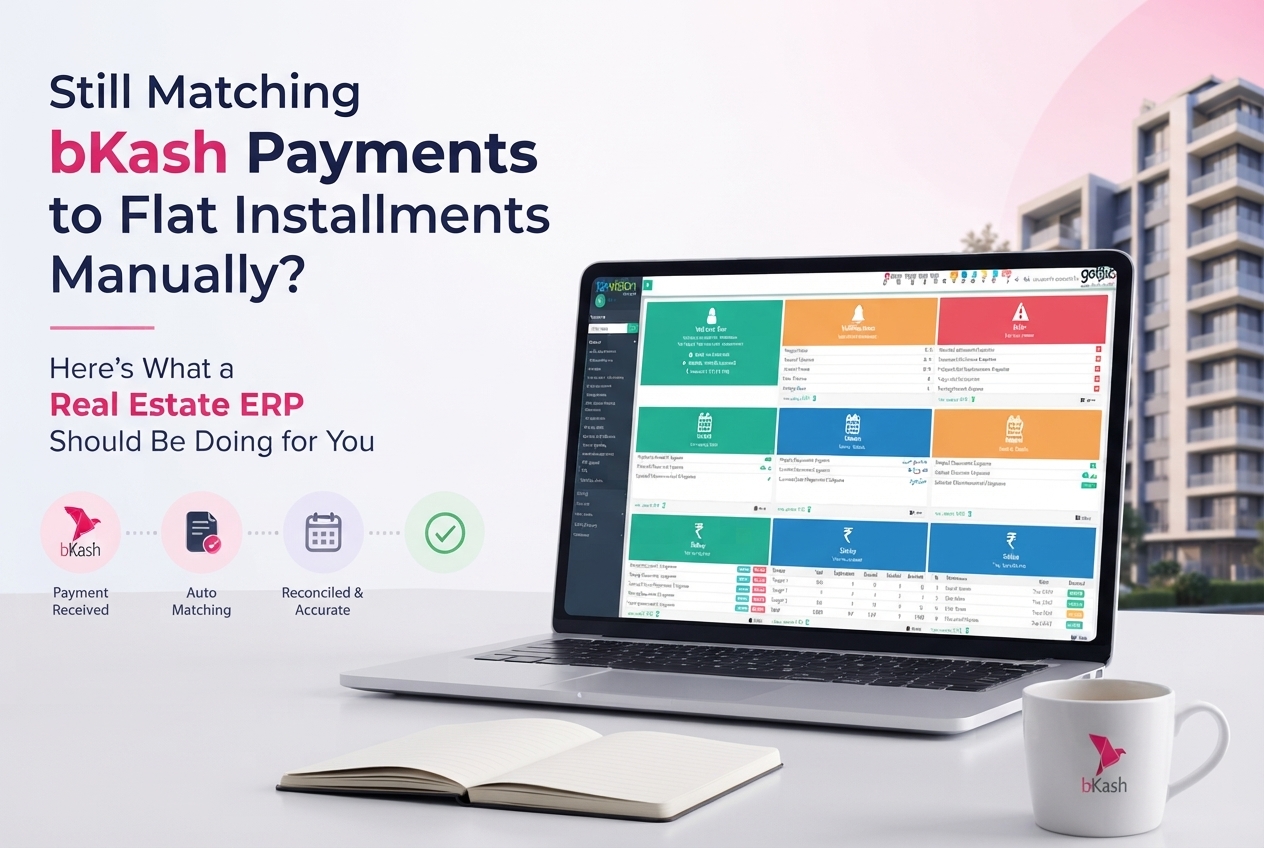
If you’re still matching bKash payments to flat installments manually, you’re not just “doing extra work”, you’re inviting avoidable errors into your cash flow. In a modern sales operation, a proper Real Estate ERP should be doing this heavy lifting for you automatically, quietly, and accurately. A proper Real Estate ERP doesn’t just record that money came in. It identifies who paid, what they paid for, which installment it belongs to, whether it is partial, whether it includes a booking token, and whether any late fees or waivers apply.
Most real estate teams don’t realize how much time they lose in that daily loop of exporting statements, searching mobile numbers, copy-pasting transaction IDs, and then trying to reconcile a customer ledger that never fully matches. The worst part is that customers often pay from a different number than the one in the file, or agents submit screenshots without proper references, and suddenly finance is stuck “guessing” which unit got paid. A Real Estate ERP should remove guessing entirely and replace it with traceability.
The Real Problem Isn’t bKash, It’s The Manual Workflow
bKash itself is not the issue. The issue is that most businesses treat bKash collections like an inbox of random notifications. Someone checks SMS, someone checks the app, someone keeps an Excel file, and at the end of the week there is a reconciliation “session” that eats hours. This manual workflow not only consumes valuable time but also increases the likelihood of errors during payment reconciliation.
In a typical project, this creates four recurring problems:
First, installment allocation becomes inconsistent. One officer may book a payment against the latest installment, another may adjust it against due amounts, and a third may hold it as “unidentified” until someone confirms. Second, reporting becomes unreliable because the same payment might be recorded twice, or recorded late, or recorded in the wrong head. Third, customers get frustrated because they paid, but the system still shows “due”. And finally, management loses real-time visibility which is dangerous when you have ongoing construction expenses, contractor bills, and milestone-based cash planning.
A well-implemented Real Estate ERP turns collections into a structured system where each transaction is linked, auditable, and instantly reflected in dashboards.
What A Real Estate ERP Should Do The Moment A bKash Payment Comes In
A strong Real Estate ERP should treat every incoming payment as a structured event that moves through a controlled workflow. Not a spreadsheet entry.
Here’s what “good” looks like in practice. When a payment comes in, the system should capture reference data, map it to a customer profile, identify the unit or booking, and auto-suggest the right allocation rules. Then it should update customer statements, receipts, and project cash flow in real time.
If you’re thinking “that sounds like a big enterprise setup,” it isn’t. With the right approach and the right ERP partner, these workflows are achievable for both mid-size developers and large groups.
Automatic Matching: The Feature Your Team Deserves
The most practical improvement a Real Estate ERP brings is automatic matching. Instead of your finance team manually hunting transaction IDs, the ERP should help them match payments using multiple identifiers such as customer phone number, booking ID, unit number, money receipt reference, agent code, or a structured payment link.
Even when payments are messy, the system should still reduce the manual work by flagging exceptions only. That means finance focuses on the 10 percent that needs attention, not the 100 percent that drains time.
In a real estate context, matching also needs to support partial payments, multiple payments in one day, combined payments for parking or utility, and adjustments such as discounts and waivers. A true Real Estate ERP is designed for these realities.
Installment Schedules That Actually Behave Like Real Estate Schedules
Most teams keep installment schedules in PDFs or Excel sheets, and they don’t update smoothly when something changes. But real projects change all the time. Payment dates shift, handover dates move, and customers negotiate.
A capable Real Estate ERP should let you build dynamic installment plans tied to booking date, construction milestones, and handover events. When a plan changes, the system should recalculate future dues and keep a clean audit trail. It should also separate principal, service charges, late fees, and miscellaneous heads so your reporting stays clean.
That’s how you stop “manual installment chaos” from becoming a permanent part of your company culture.
Customer Ledger, Money Receipts, And Tax Documents In One Flow
One of the biggest pain points in manual operations is document inconsistency. A customer asks for a statement, finance sends one version. Sales sends another. Accounts has a third.
A Real Estate ERP should generate a single source of truth: customer ledger, unit ledger, project ledger, and bank or wallet ledger that all reconcile. Money receipts should be generated instantly with unique numbering, approval rules, and proper authorization. If you need tax-related documents, those should also be pulled from the same verified dataset, not rebuilt manually each time.
When this is done correctly, customer trust increases because every “paid” amount appears correctly, and your internal team stops wasting time defending the numbers.
Real-Time Dashboards: Stop Waiting For Month-End To Understand Cash
A Real Estate ERP should give management a live view of collections, receivables, overdue installments, and projected cash flow. Not next week. Not after the accounts team compiles a report.
This matters because real estate operations are cash-sensitive. You may have contractor payments, procurement cycles, land payments, and regulatory fees that depend on predictable collections. When dashboards are real-time, decisions become proactive.
And this is also where modern ERP systems shine with AI-driven insights, trend alerts, and forecasting views. Instead of looking at static reports, you see risk early, such as increasing overdue ratios in a certain tower, agent-wise underperformance, or a sudden slowdown after a price revision.
Approvals And Controls: The Stuff That Protects You Quietly
In real estate, small control gaps become expensive. Unauthorized discounts, unapproved waivers, backdated entries, or receipt cancellations can distort your accounts and create compliance risks.
A solid Real Estate ERP should support role-based access, granular security, and structured approval workflows. For example, a discount request should move from sales to finance to management based on rules. A cancellation should require approval and leave a trace. A backdated posting should be flagged.
This is where zero-code workflow creation becomes valuable. You can implement the controls you actually need, without making your team feel like they are fighting the software.
Why This Matters In Bangladesh: Growth Has Outpaced Systems
In Bangladesh, many developers scale faster than their internal systems. Projects multiply, sales channels expand, and payment methods diversify. Suddenly you’re dealing with bKash, bank transfers, cheques, card payments, and sometimes multiple collection points. The old spreadsheet-plus-accounting-software approach breaks under volume.
That’s why companies searching for ERP software Bangladesh options increasingly ask one core question: “Will it fit our real workflow?” In real estate, the workflow is not generic accounting. You need unit-based tracking, booking lifecycle management, installment schedules, customer communication, and collections reconciliation. That’s why a purpose-driven Real Estate ERP setup is a practical upgrade, not a luxury.
What To Look For In A Real Estate ERP
When people compare the best ERP software in Bangladesh, they often focus on interface and generic modules. That’s fine, but real estate success depends on the boring details: mapping payments correctly, managing due schedules, and producing clean statements instantly.
A reliable Real Estate ERP should give you:
- Strong finance core with real estate-specific allocation logic, customer and unit ledgers, and automated receipt workflows.
- Flexible deployment choices, including cloud ERP Bangladesh options, on-premises, or hybrid, depending on your control and compliance needs.
Everything else is secondary if these two pieces are weak.
Also, don’t ignore integration. Many firms already use tools like Tally, SAP, or QuickBooks in parts of the business. A modern ERP should integrate smoothly so you don’t create new data silos.
Where Infoex Bangladesh Fits In
At Infoex Bangladesh, we simplify enterprise management through next-generation ERP software solutions that align technology with real business goals. As a certified partner and distributor of Focus ERP, Farvision ERP, and Impact+ ERP systems, we help organizations move toward full digital transformation, including complex finance workflows and multi-entity operations.
For real estate businesses, modularity is a big win. With Focus solutions like Focus 9, Focus X, Focus WMS, Focus MRP, and Focus POS, teams can start with what they need now and expand later. Some firms begin with Finance and CRM, then add Inventory, HRMS, approvals, or mobile access as operations scale. This “start small, scale cleanly” approach is often ideal for developers who want a Real Estate ERP foundation without forcing a disruptive big-bang rollout.
This is where the concept of modular ERP comes into play. It allows businesses to have flexible and scalable systems that can adapt to their evolving needs.
If you also operate business units outside real estate, like trading, retail, or light manufacturing, that same modular approach keeps everything under one umbrella. Many groups in Bangladesh care about this because they want a single ERP backbone across multiple concerns from finance to distribution. That’s also why searches for things like ERP software for SME Bangladesh and ERP software company in Bangladesh have become so competitive. Businesses want an ERP partner that can grow with them.
Don’t Overpay, But Don’t Underbuild: Understanding Cost The Right Way
When buyers ask about ERP software price in Bangladesh, it’s usually because they’ve seen wild ranges. One vendor quotes a low number for a basic accounting setup. Another quotes higher for a complete ERP rollout. The confusion is understandable.
A better way to think about cost is: what portion of your current manual process are you eliminating, and what risk are you removing? Manual reconciliation costs you time daily, and errors cost you credibility and cash predictability. The real return on a Real Estate ERP shows up in faster collections confirmation, fewer disputes, tighter controls, and decision-ready reporting.
You should also ask directly about ERP implementation cost Bangladesh for your project scope, especially if you need custom workflows, integrations, or data migration. A good implementation partner will explain what’s included, what’s optional, and what can be phased.
Real Estate Operations Don’t Live Alone: Inventory And Warehouse Matter Too
Some developers underestimate how much inventory discipline matters in real estate. Not just cement and rods, but also tiles, fittings, electrical items, sanitary ware, and project-wise consumption tracking. Without control, leakage happens quietly.
This is where pairing a Real Estate ERP with inventory management software Bangladesh capabilities becomes useful. If you operate central stores or multiple sites, you may also need warehouse management software Bangladesh features such as barcode handling, GRN flows, and stock transfers. Focus WMS can play a role here for businesses that want stronger warehouse discipline.
And if your company has a manufacturing wing, such as pre-cast, blocks, or steel fabrication, then modules aligned with ERP for manufacturing Bangladesh and manufacturing ERP software Bangladesh become relevant too. Many groups in Bangladesh operate diversified structures, which is also why keywords like garments ERP software Bangladesh and best garments erp software in Bangladesh often appear in ERP shortlists. Even if garments is not your sector, it signals a market expectation: ERP should be industry-ready, not generic.
How A Real Estate ERP Changes Your Daily Work
Before ERP, a typical day looks like: bKash notifications arrive, someone screenshots, finance types entries, sales keeps a parallel tracker, customers call, and at month-end everyone rushes to “make it match.”
After a proper Real Estate ERP rollout, bKash and other payment entries become standardized, allocations follow rules, exceptions get flagged, and statements are always ready. Sales sees updated payment status, finance sees reconciled collections, and management sees real-time project cash.
That is what “digital transformation” should feel like: fewer follow-ups, fewer arguments, fewer unknowns.
Getting Started Without Disrupting The Business
If you’re considering a Real Estate ERP, start by documenting your current payment flow. What references do customers include? Who confirms payments? How do you generate receipts? Where does installment scheduling live? Then map the exceptions: wrong numbers, partial payments, advance payments, and agent-mediated collections.
Once you have that, an ERP demo Bangladesh session becomes genuinely useful because you can ask the right questions and validate the workflow. Don’t settle for generic screens. Ask the vendor to show your exact flow with your rules.
If you are comparing vendors from the top 10 erp software in Bangladesh lists, use that shortlist wisely. Evaluate who can implement, who can support, and who understands operational details, not just software features.
FAQs
What Problems Does A Real Estate ERP Solve For bKash Collections?
A Real Estate ERP auto-matches payments to customers and installments, generates receipts, updates ledgers instantly, and flags exceptions. It reduces manual effort, prevents duplicate entries, and improves customer statement accuracy.
How Do We Estimate ERP Software Price In Bangladesh For Real Estate?
ERP software price in Bangladesh depends on modules, users, deployment type, integrations, and customization. A Real Estate ERP quote should separate license, implementation, training, and support so you can plan phased rollout.
Is Cloud ERP Bangladesh Safe For Financial And Customer Data?
Yes, if configured properly. Cloud ERP Bangladesh setups should include role-based access, approvals, audit logs, and granular security. A Real Estate ERP partner should also guide backups, data ownership, and compliance controls.
Can A Real Estate ERP Also Handle Inventory And Store Management?
Yes. Many Real Estate ERP deployments include inventory management software Bangladesh features, and for larger operations, warehouse management software Bangladesh workflows like GRN, transfers, and barcode-based stock control.
What Should We Ask During An ERP Demo Bangladesh Session?
Bring your real workflow. Ask the Real Estate ERP vendor to demonstrate installment schedules, partial payments, receipt approvals, ledger views, exception handling, and reporting. Generic demos look good but often miss real operational complexity.
Get Started With Infoex Bangladesh
If you’re tired of chasing bKash screenshots, fixing mismatched ledgers, and explaining “why the statement looks different,” we can help. At Infoex Bangladesh, we implement Real Estate ERP systems that automate collections, tighten controls, and give you real-time visibility, without forcing a messy, disruptive rollout. Reach out to us for a practical assessment and an ERP demo tailored to your exact workflow.