



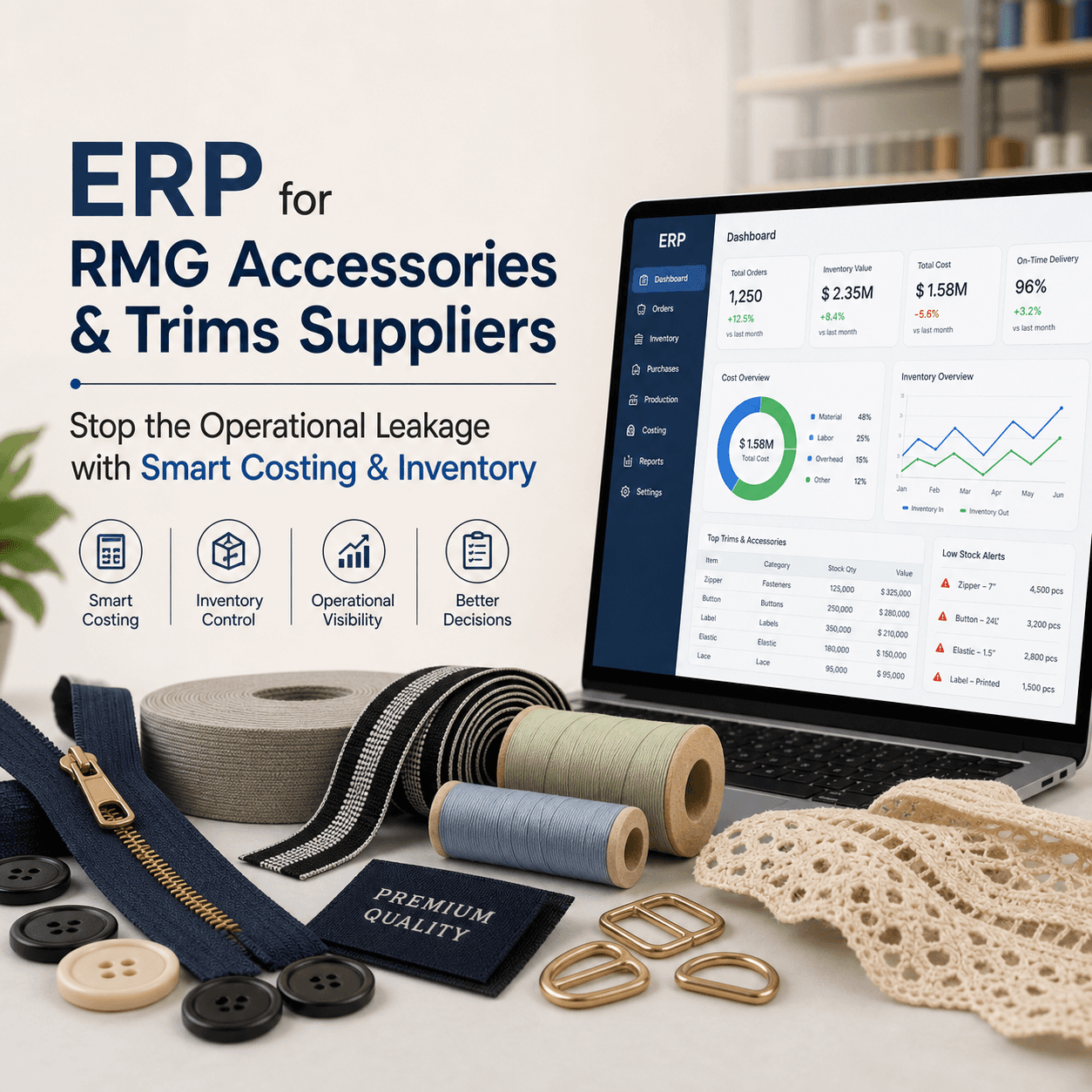
Operational leakage is a significant issue in the trims and accessories sector. It occurs due to factors such as incorrect costing, missing stock, late claims, and poor batch traceability. However, deploying a specialized ERP for garments accessories supplier Bangladesh can effectively mitigate this leakage by establishing a single version of truth. It seamlessly connects costing, purchasing, stores, production, and dispatch into one cohesive flow, proving essential for growth-focused manufacturers.
If your business supplies labels, buttons, zippers, threads, elastics, poly, carton, tags, hangers, tapes, interlining or packaging, you’re already managing a high-SKU business. This also means you operate in a high-variance environment where color, size, finish, and buyer rules frequently change. At this scale, manual control becomes ineffective.
A modern ERP provides the necessary control without hindering your speed.
Summary of what you should do to reduce leakage fast

To swiftly minimize leakage, you need to standardize costing, manage inventory by batch control and link every movement to a job. Locking approvals and tracking claims are also crucial. An ERP system makes these controls part of your daily routine instead of a monthly cleanup task.
Key takeaways you can apply this month
- Profit loss mainly arises from costing gaps and stock mismatch.
- SKU, batch and location level inventory control is essential.
- Buyer-wise specs and approvals should be integrated within the workflow.
- Job-wise costing with real issue and consumption data is necessary.
- Real-time dashboards are vital for early exception detection.
- A modular ERP allows you to start small and scale safely.
Why leakage is higher in trims and accessories than most factories
Leakage is higher because variability is built in. You manage more SKUs than many garment factories. You also manage frequent style changes. You manage buyer compliance. You often manage short lead times.
Small errors multiply quickly. One wrong carton spec can trigger a claim. One wrong shade can cause rejection. One missed issue entry can create phantom stock.
Do you see these patterns in your business?
You likely see sudden negative stock. You likely see overbuying “just in case.” You likely see job margins moving after delivery. Those are leakage signals.
What “smart costing” means for accessories and trims suppliers
Smart costing means job-wise costing that updates from real transactions. It does not stay static in Excel. It also means you price by spec and process. You include wastage rules, setup, and rework risk.
In trims, costing is not only material. It includes process cost. It includes packing. It includes testing. It includes freight and duty. It includes rejection risk.
ERP-based costing links these elements to the same job.
How ERP prevents under-quoting and silent margin loss
ERP prevents under-quoting by storing cost drivers. It also enforces templates. It can warn you when input costs changed. It can also track buyer-wise margin targets.
You stop relying on memory.
You stop relying on last month’s sheet.
Smart costing fields you should track in ERP
You should track GSM, width, finish, and shade. You should track supplier lead time and MOQ. You should track conversion factors. You should track wastage by process. You should track test costs and inspection costs.
If you do not track them, you guess them.
Inventory control fails when SKU rules are weak

Inventory fails when SKU naming is inconsistent. It also fails when locations are not mapped. It fails when batch and lot tracking is missing. It fails when issues happen without approvals.
ERP fixes this with structure.
You need SKU discipline, but you also need speed
You can keep speed if the ERP supports barcode and QR. You can receive stock with scanners. You can issue by picking lists. You can do cycle counts fast.
This is not theory. This is daily control.
Batch, shade, and lot traceability is not optional now
Buyers ask for traceability more often in 2025. They want proof of source. They want proof of test. They want proof of lot use.
If a claim comes, you must answer fast. ERP helps you trace from GRN to delivery.
What we tested: a small leakage study with real numbers
Leakage is hard to accept without numbers. So we ran a simple study. We used internal onboarding observations from Infoex Bangladesh. We reviewed 12 Bangladeshi trims and accessories suppliers. The period was January to March 2026. Each company shared one month of transaction exports. We anonymized company names. We only used aggregated results.
Method: We matched three things. We matched physical stock count snapshots. We matched ERP or software stock ledgers where available. We matched Excel and manual logs. We then tagged root causes.
Result: The average inventory mismatch was 2.8% of monthly inventory value. The range was 0.9% to 6.1%. The top drivers were unposted issues, wrong UOM conversion, and returns not recorded.
Source: Infoex Bangladesh Operational Leakage Review, 2026 (internal aggregated analysis, available on request).
Why 2.8% matters more than you think
2.8% sounds small. It is not small. If your average stock is BDT 10 crore, that is BDT 28 lakh. That can erase your monthly profit.
Do you track mismatch as a KPI today?
ERP for trims suppliers must support buyer-wise specs and approvals
Your business runs on buyer rules. Each buyer has packaging rules. Each buyer has testing rules. Each buyer has labeling rules.
ERP must store these rules. It must also enforce them in workflow.
Role-based approvals stop wrong dispatch and wrong purchase
Role-based approvals block risky actions. They stop wrong price. They stop wrong PO terms. They stop unapproved substitutions.
With zero-code workflows, you can change approval paths fast. You do not need developers.
This matters when buyers change demands mid-season.
How ERP connects order, BOM, and production for trims
ERP should link sales order to BOM or routing. It should link the job card to issues. It should link to production output. It should also link to packing and delivery.
This flow gives you job-level traceability.
Job-wise consumption control reduces over-issuing
Over-issuing is a silent loss. It happens when store issues “a bit extra.” It happens without tracking. It becomes normal.
ERP forces issue against job. It shows variance. It shows who issued. It shows when it happened.
Would you like to see variance the same day?
You should.
Which ERP modules matter most for accessories and trims suppliers
You do not need everything on day one. You need modules that stop leakage first. Then you scale.
At Infoex Bangladesh, we simplify enterprise management through next-generation ERP software solutions that align technology with your business goals. As a certified partner and distributor of Focus ERP, Farvision ERP, and Impact+ ERP systems, we help organizations achieve full digital transformation from finance and manufacturing to retail and logistics.
Our modular ERP solutions like Focus 9, Focus X, Focus WMS, Focus MRP, and Focus POS can be used as a full system or started with standalone modules. You can begin with Finance, HRMS, CRM, Inventory, or POS. The system supports single companies and multi-country groups. It supports cloud, on-premises, and hybrid deployment.
These systems not only support integration with Tally, SAP, and QuickBooks but also offer high customization and zero-code workflow creation. It includes AI-driven insights, real-time dashboards, mobile access, and barcode and QR generation making it suitable for complex manufacturing and growing enterprises due to scalability and modular design.
However, it’s essential to understand what an ERP system is in order to fully leverage its potential.
The best-fit ERP workflow for a trims supplier looks like this
A best-fit workflow is simple and strict. It reduces freedom where freedom causes loss. It gives freedom where speed matters.
Here is the flow most suppliers need:
Sales order comes with buyer specs. Costing confirms margin. Purchase plan confirms materials. GRN records lot and shade. Stores issues by job and BOM. Production posts output and rejects. QC records results. Packing follows buyer rules. Dispatch prints compliant documents. Finance posts invoice and tracks claims.
That is one connected loop.
How WMS and barcode reduce warehouse mistakes
A Warehouse Management System (WMS) reduces picking mistakes, while barcodes minimize entry errors. Together, they effectively reduce both types of errors.
In a warehouse with multiple racks and bins, location control becomes essential. Without it, time is wasted and items can easily be misplaced.
What you gain with WMS in a trims warehouse
Implementing a WMS brings several advantages to a trims warehouse. You gain faster receiving processes, guided put-away strategies, and the ability to implement FIFO or FEFO rules. You also benefit from batch tracking, which streamlines inventory management. Additionally, cycle counts become quicker and more efficient.
Accountability is another significant gain from using a WMS.
What to compare when choosing ERP for accessories and trims suppliers
When selecting an ERP system for accessories and trims suppliers, it’s important to compare by fit rather than brand. Key factors to consider include transaction depth, traceability, workflow control, and reporting capabilities.
To simplify this comparison process, use a straightforward table like the one below:
| Requirement | Why it matters for trims | What “good” looks like |
| Batch / lot / shade tracking | Claims and rejections need fast traceability | Trace from GRN lot to dispatch invoice in seconds |
| Job-wise costing and variance | Margins shift due to wastage and rework | Planned vs actual by job, by item, by process |
| UOM conversion control | Meter, yard, kg, pcs conversions cause mismatch | Locked conversions with approval and audit trail |
| Buyer-wise specs and packing rules | Non-compliance creates chargebacks | Specs attached to SO, enforced at packing and dispatch |
| Role-based approvals | Stops risky purchases and wrong dispatch | Zero-code workflows with escalation and logs |
| Dashboards and mobile access | Exceptions must be visible daily | Real-time KPIs on web and mobile |
By keeping these factors in mind while making your selection, you can ensure that the chosen ERP system meets the specific needs of your accessories and trims business.
What KPIs you should watch daily to stop leakage early

You should watch a small set daily. You can review deeper weekly. Daily KPIs should catch exceptions.
Track stock mismatch alerts. Track negative stock events. Track job variance above threshold. Track late GRN against plan. Track dispatch holds due to QC.
One dashboard can show these.
Do you need cloud ERP or on-premises ERP in Bangladesh
Most trims suppliers can run cloud. Cloud reduces IT load. It improves remote access. It speeds updates.
On-premises fits when you need strict internal control. It also fits when internet is unstable. Hybrid fits when you want both.
The right answer depends on your risk and team.
A modular ERP lets you choose without rework.
Integration matters because you already use other tools
You likely use Tally or QuickBooks. You might use SAP in a group setup. You might use custom tools for lab testing.
ERP should integrate cleanly. Integration reduces double entry. It also reduces mismatch.
Focus ERP supports integration with Tally, SAP, and QuickBooks. That matters when finance must stay stable during rollout.
A practical rollout plan that does not disrupt production
You should start with leakage-heavy areas. You should avoid a “big bang.” You should go module by module.
A common safe sequence is Inventory + Finance first. Then Sales and Purchase. Then Production and QC. Then WMS. Then BI dashboards and mobile.
You keep operations running. You still improve control.
Common questions trims suppliers ask before buying ERP
Will ERP slow down dispatch?
No, if barcode, workflows, and templates are set right. It speeds dispatch after training. It also reduces rework and buyer complaints.
Can we start with only Inventory and Finance?
Yes. Modular ERP supports phased rollout. You can add HRMS, CRM, MRP, and WMS later. You scale when your team is ready.
FAQs
What is the biggest profit leak for trims suppliers?
The biggest leak is silent margin erosion. It comes from weak costing and stock mismatch. ERP fixes both by linking job costing to actual issues, receipts, and wastage.
Can ERP handle thousands of SKU variations like size and shade?
Yes. A good ERP supports attributes, batch and lot, and location tracking. It also supports barcode and QR, which keeps transactions fast and accurate.
How does ERP reduce buyer claims and chargebacks?
ERP stores buyer-wise specs and packing rules. It enforces approvals and QC holds. It also provides traceability from GRN lot to dispatch, which speeds claim response.
Do we need WMS if we already have a store ledger?
If you have many racks, bins, and fast movement, you need WMS. It controls locations, picking, put-away, and cycle counts. It reduces mispicks and missing stock.
How long does an ERP rollout take for accessories suppliers?
It depends on modules and data quality. Many suppliers go live with Inventory and Finance in weeks, then add production, WMS, and dashboards in phases without disruption.
Let’s stop leakage before it becomes your “normal”
At Infoex Bangladesh, we see leakage patterns every week. We also see how fast they drop with the right ERP design. If you want tighter costing, cleaner inventory, and fewer claims, we can help you map the gaps and implement a modular ERP that fits your workflow. Reach out to us for a focused assessment and a rollout plan that your team can actually run.