



If you run a manufacturing business here, you already know how quickly costs can slip out of your hands. One delayed purchase order becomes an emergency air shipment. One inaccurate bill of materials quietly inflates your material issue. One untracked machine breakdown wipes out the week’s efficiency. This is exactly why Custom Manufacturing ERP software in Bangladesh has become less of a “nice-to-have” and more of a practical requirement for serious cost control. When your costing, inventory, production, quality, and finance are connected in one system (and customized to match how your factory truly works), you stop reacting to cost problems and start preventing them.
In this article, we’ll break down why Custom Manufacturing ERP software in Bangladesh is so important for controlling costs, what it fixes in real-world factory operations, and how modern modular ERP (like Focus ERP suites) helps you scale without drowning in complexity.
The Real Cost Control Problem In Bangladeshi Manufacturing
Cost control in manufacturing is not only about negotiating a better rate with suppliers. It’s about controlling “leaks” that happen every day across procurement, stores, production, rework, maintenance, and dispatch. In Bangladesh, many plants still operate with a mix of spreadsheets, manual registers, and disconnected software for accounts, inventory, and sales. The result is simple: you get reports, but you don’t get control.
Here are a few common situations where costs silently rise:
A purchase team buys at a higher rate because they cannot see current stock, in-transit items, or consumption trends. Production consumes extra materials due to outdated BOMs, wrong issue quantities, or poor batch tracking. Rework increases because quality checks are recorded late, or not tied to production lots. Finance receives costs after the month ends, meaning decisions are based on old information. In this environment, Custom Manufacturing ERP software in Bangladesh becomes the tool that brings cost visibility into the present, not the past.
Why “Custom” Matters More Than Most People Think
A generic ERP setup might digitize your data, but it often fails to match the reality of your factory. Bangladesh has diverse manufacturing segments, such as garments and textiles, plastics, FMCG, pharmaceuticals, steel, cables, ceramics, furniture, packaging, and contract manufacturing. Each has unique costing structures, production flows, compliance requirements, and quality checkpoints.
That’s why Custom Manufacturing ERP software in Bangladesh matters. Customization is not about making the software complicated. It’s about making the software reflect your actual workflows so people follow the system instead of bypassing it.
For example, a factory may need multi-level BOM, alternate materials, by-products, wastage rules, route cards, subcontracting processes, batch traceability, or approval workflows that match internal controls. When those are modeled correctly inside ERP, cost control becomes a daily operational outcome, not an accounting exercise at month-end.

How Custom Manufacturing ERP Software In Bangladesh Controls Costs (In Practical Terms)
The biggest advantage of Custom Manufacturing ERP software in Bangladesh is that it connects cost drivers that are usually separated. Let’s walk through the cost areas it improves, with examples you’ll recognize.
Material Cost Control Through Accurate Inventory And Smart Procurement
Materials are typically the largest cost bucket in most manufacturing operations. ERP helps you control this by ensuring you buy the right quantity, at the right time, at the right rate, with full visibility.
With Custom Manufacturing ERP software in Bangladesh, you can track stock by warehouse, bin, batch, lot, or even barcode and QR-based identification. You can see reorder points, min-max levels, consumption patterns, and lead times. Purchase requisitions can be tied to production plans so “urgent” buying reduces. Supplier comparison becomes easier because rates, delivery performance, and quality rejections are recorded consistently.
If your ERP also supports integration with tools like Tally, SAP, or QuickBooks, you can unify purchasing and accounting without duplicate entry. That means fewer mismatches in GRN vs invoice, fewer payment errors, and better control over landed cost.
Production Cost Control With Real-Time Work Orders And BOM Discipline
Many factories lose money simply because production execution is not tied tightly to standards. A BOM exists, but it’s not enforced. A work order exists, but consumption is not tracked at the right time. Supervisors estimate output, and actuals are adjusted later.
Custom Manufacturing ERP software in Bangladesh fixes this by making production structured and measurable. When work orders are created from demand or forecast, the system can reserve materials, guide issues, and record actual consumption and output. If your processes include stages (cutting, mixing, molding, finishing, packing), ERP can reflect those steps so you know where losses happen.
The moment you enforce BOM and routing discipline, you get cleaner variance reporting: material variance, labor variance, and overhead variance. That is cost control you can act on quickly.
Wastage, Scrap, And Rework Control With Better Traceability
Wastage is not always avoidable, but it must be measurable. In many setups, wastage becomes an assumed percentage. The real wastage may be higher, but it remains hidden.
With Custom Manufacturing ERP software in Bangladesh, you can define wastage rules in BOM, track scrap by reason codes, and monitor rework loops. More importantly, if you support batch and lot traceability, you can connect quality issues to specific raw material batches, production shifts, lines, or machines. That helps you fix root causes instead of blaming “general production problems.”
Maintenance And Downtime Costs Reduced With Planned Visibility
Machine downtime is a direct cost and an indirect cost at the same time. You lose output, you waste labor hours, and you often create more rejects due to unstable processes.
A properly configured ERP with manufacturing support can track machine breakdowns, maintenance schedules, spare parts consumption, and downtime reasons. When maintenance is planned and spare parts are managed through inventory, emergency purchases reduce, overtime reduces, and production planning becomes more realistic.
This is another reason Custom Manufacturing ERP software in Bangladesh delivers ROI: it prevents the expensive chaos that happens when maintenance data sits in a separate notebook.
Labor And Overhead Control Through Better Tracking And Approvals
In many factories, labor and overhead get treated as fixed costs. But even if wages are fixed, labor efficiency is not fixed. Overhead wastage is not fixed either. Utilities, overtime, idle time, and shift productivity vary, and ERP helps you see those variations.
With Custom Manufacturing ERP software in Bangladesh, you can tie labor to work orders, track shift outputs, record overtime approvals, and monitor productivity by line or department. For overheads, ERP helps allocate costs more accurately using cost centers and defined allocation rules. When overhead allocation becomes consistent, you get more reliable product costing, which improves pricing decisions.
Role-based approvals and granular security add another layer of control. When every purchase, discount, and adjustment follows an approval workflow, costs don’t leak through informal exceptions.
Finance-Led Cost Control With Real-Time Dashboards, Not End-Of-Month Surprises
Finance teams can’t control what they can’t see. If accounts receive data late, finance becomes a reporting function instead of a control function.
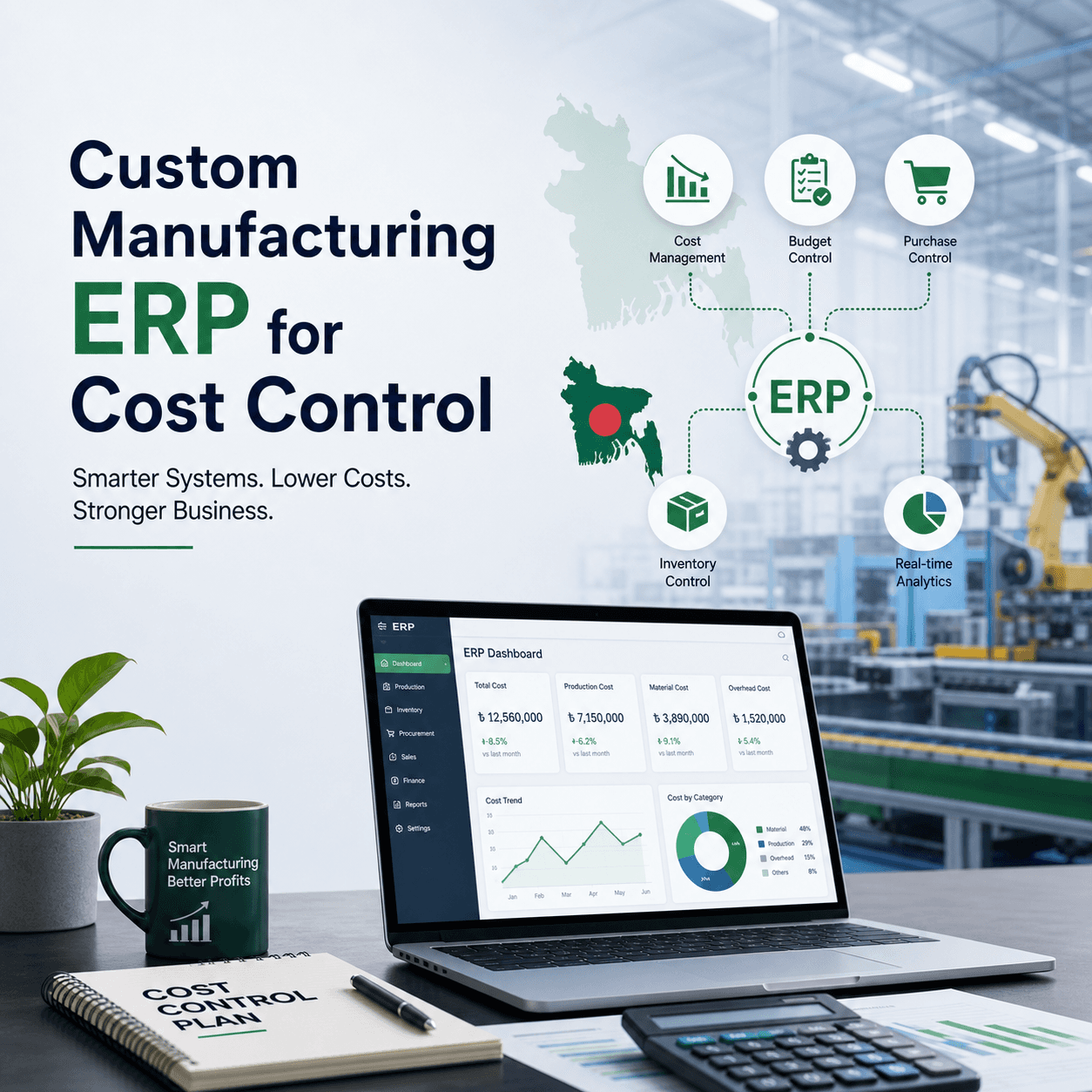
Modern Custom Manufacturing ERP software in Bangladesh provides real-time dashboards for inventory valuation, production cost, purchase price variance, WIP value, receivables, payables, and profitability. With AI-driven insights and alerts, you can catch abnormal trends early, like sudden consumption spikes, unusual scrap rates, or cost increases for specific SKUs.
This is where cost control becomes proactive. Instead of “we’ll analyze after month closing,” you can take action in the same week.
Why Modular ERP Is A Better Fit For Growing Manufacturers
One reason some manufacturers hesitate to implement ERP is the fear of big-bang projects. But modular ERP changes that. You can start with what hurts the most and expand as you mature.
Focus ERP suites, for example, are designed in modular form. Businesses can begin with Finance, Inventory, HRMS, CRM, or POS, and then scale into production, MRP, WMS, and advanced analytics. That flexibility matters in Bangladesh, where many companies are growing fast and adding new units, new product categories, and sometimes even multi-country operations.
With Custom Manufacturing ERP software in Bangladesh, the key is that modular expansion still keeps a single data backbone. You don’t build a patchwork of tools that create reconciliation headaches later.
What “Good ERP Customization” Looks Like (Without Breaking The System)
Customization gets a bad reputation when it creates fragile systems. But strong ERP platforms allow customization in a controlled way, using configuration, workflows, and extensions that don’t ruin upgrades.
A modern ERP can support zero-code workflow creation, custom approvals, custom forms, role-based access, and tailored dashboards. In manufacturing, that means you can match your costing logic, production steps, and compliance requirements without forcing your teams into awkward processes.
If you want a simple benchmark, Custom Manufacturing ERP software in Bangladesh should do three things well:
It should match your operational reality, it should protect internal controls, and it should still remain scalable and upgrade-friendly.
Cost Control Use Cases You Can Expect In The First 90 Days
If the ERP implementation is done properly, manufacturers typically see early cost control wins in a few areas. These are not theoretical improvements. They are the kinds of wins that show up in your day-to-day.
First, inventory accuracy improves when barcode or QR processes are introduced, which reduces emergency purchases and stock variance adjustments. Second, purchase control improves when approval workflows and supplier comparisons become part of the standard process. Third, production consumption becomes measurable, so wastage and scrap discussions become data-driven.
This is why Custom Manufacturing ERP software in Bangladesh is increasingly adopted by factories that want to stay competitive on pricing while protecting margins.

Why Infoex Bangladesh Focuses On ERP That Fits Manufacturing Reality
At Infoex Bangladesh, we simplify enterprise management through next-generation ERP software solutions that align technology with business goals. We work as a certified partner and distributor of Focus ERP, Farvision ERP, and Impact+ ERP systems, supporting full digital transformation across finance, manufacturing, retail, and logistics.
For manufacturers, Focus ERP solutions such as Focus 9, Focus X, Focus WMS, Focus MRP, and Focus POS can be used as a complete suite or as standalone modules depending on business needs. Many companies start small with Finance, HRMS, CRM, Inventory, or POS, then expand into full manufacturing planning and warehouse automation as their operations grow. Cloud, on-premises, and hybrid deployment options make it easier to adopt ERP in a way that fits your IT comfort level.
More importantly for cost control, these systems support high customization, zero-code workflow creation, role-based approvals, granular security, integration with tools like Tally, SAP, and QuickBooks, real-time dashboards, mobile access, and barcode or QR workflows. That combination is exactly what manufacturers need when they want Custom Manufacturing ERP software in Bangladesh that is practical, scalable, and built for complex operations.
Choosing The Right ERP For Cost Control: A Quick Reality Check
Before you select any solution, it helps to evaluate based on how you actually lose money today. Cost control is not one single feature. It’s the outcome of many connected controls working together.
Here are a few must-check areas for Custom Manufacturing ERP software in Bangladesh:
- Whether the system supports your costing method (standard, average, FIFO, batch-wise) and variance reporting.
- Whether production, inventory, quality, and finance truly work in one flow without duplicate entry.
- Whether approvals, security, and audit trails are strong enough for internal control and growth.
If an ERP cannot reflect your real processes, teams will work around it. And the moment people work around the system, you lose cost control again.
Let’s Wrap Up
Cost control is not about squeezing your teams harder. It’s about giving them a system that prevents mistakes, reduces guesswork, and surfaces issues early. That’s why Custom Manufacturing ERP software in Bangladesh has become one of the most practical investments a manufacturer can make. When BOMs are enforced, inventory is accurate, procurement is visible, production is measurable, and finance gets real-time dashboards, your costs stop being a mystery.
If you’re serious about reducing wastage, improving purchasing discipline, controlling production variances, and protecting margins, Custom Manufacturing ERP software in Bangladesh is one of the most direct paths to getting there, especially when it’s modular enough to start small and scale as you grow.
FAQs
What Makes Custom Manufacturing ERP Software In Bangladesh Better For Cost Control Than Generic ERP?
Generic ERP often misses factory-specific workflows like multi-stage production, wastage rules, batch tracking, and approvals. Custom Manufacturing ERP software in Bangladesh matches your real processes, preventing data gaps that cause hidden costs.
How Fast Can We See Results After Implementing Custom Manufacturing ERP Software In Bangladesh?
Many manufacturers see early improvements within 60 to 90 days, especially in inventory accuracy, purchase approvals, and production consumption visibility. Faster results depend on process clarity, training, and clean master data.
Can Custom Manufacturing ERP Software In Bangladesh Work With Our Existing Accounting Tools?
Yes. Many modern ERP platforms support integration with popular tools like Tally, SAP, and QuickBooks. This reduces duplicate entry, improves reconciliation, and strengthens finance-led cost control across departments.
Is Modular ERP A Good Fit For Mid-Sized Factories In Bangladesh?
Absolutely. Modular ERP lets you start with Finance, Inventory, HRMS, CRM, or POS, then expand into MRP, WMS, and manufacturing modules. This approach reduces upfront complexity and supports gradual digital transformation.
How Does Custom Manufacturing ERP Software In Bangladesh Reduce Wastage And Scrap?
It enforces BOM discipline, tracks actual consumption, records scrap with reason codes, and supports batch or lot traceability. This makes wastage measurable, improves accountability, and helps identify root causes quickly.
Talk To Us At Infoex Bangladesh
If you’re trying to control costs but still relying on spreadsheets and disconnected tools, we can help you move to a system that actually matches your factory’s reality. At Infoex Bangladesh, we implement modular, scalable ERP that brings production, inventory, and finance into one cost-controlled workflow. If you want Custom Manufacturing ERP software in Bangladesh that fits how you operate today and scales for tomorrow, let’s talk and map the smartest path forward.