



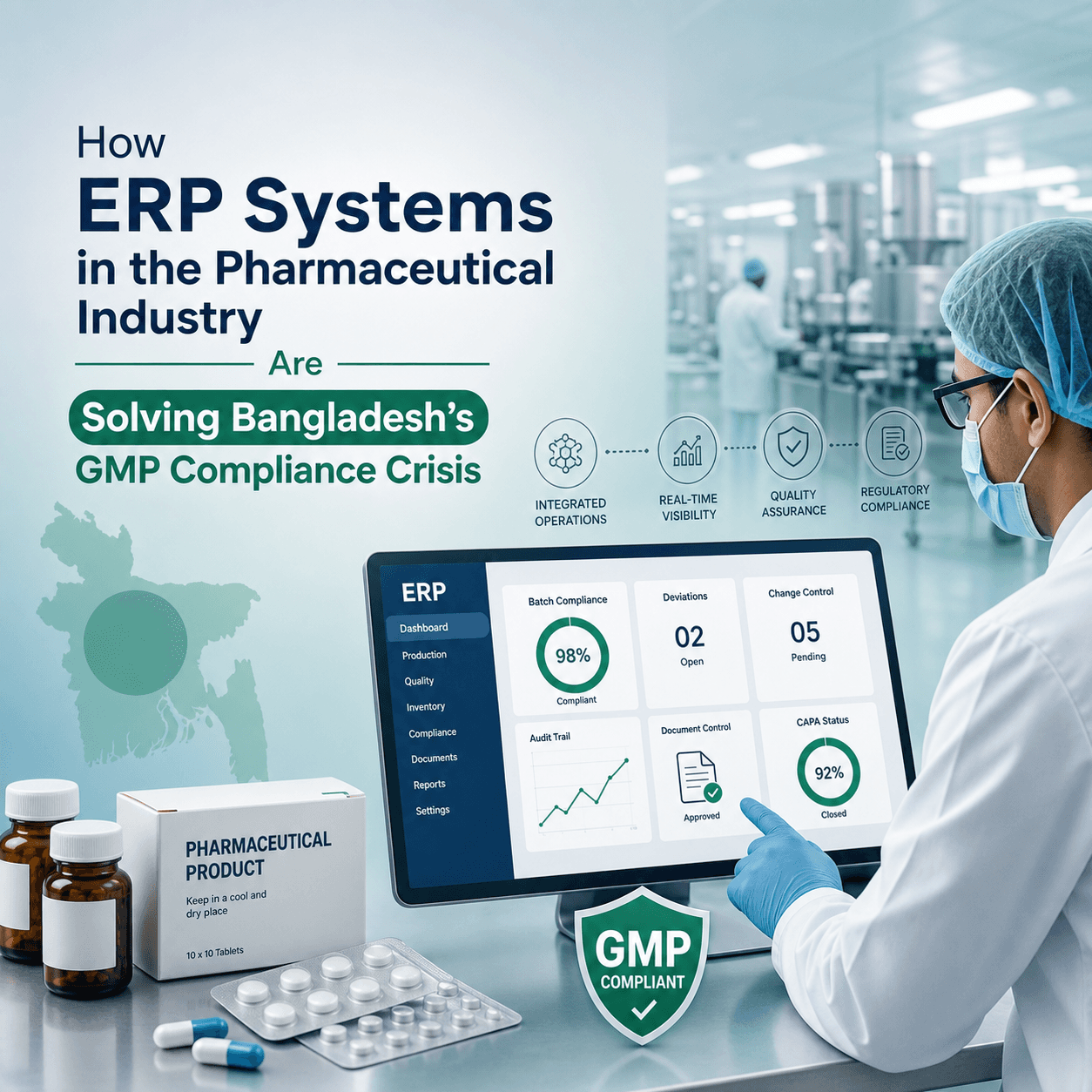
Bangladesh’s pharmaceutical sector has a rare advantage: it’s one of the few industries in the country that competes confidently on a global stage. But behind the export wins and brand growth, there’s a reality most quality and operations teams feel every day, especially when managing the complexities of an erp system in pharmaceutical industry environments. GMP compliance, such as the Good Manufacturing Practice guidance, is getting harder, not easier.
Not because people don’t care, but because the system is stretched. Documentation is still too manual. Batch records are still too fragmented. Deviations still take too long to investigate. Approvals still move through inboxes and paper files. And when auditors ask for evidence, teams often end up “hunting” instead of “showing.”
That’s where ERP comes in, not as a generic IT upgrade, but as a compliance engine. In Bangladesh, ERP is quietly becoming the practical solution to a very real GMP crisis: too many processes, too many handoffs, and not enough controlled, traceable data.
The real GMP problem in Bangladesh isn’t standards

Most pharmaceutical manufacturers in Bangladesh know what GMP demands. The challenge is consistently executing GMP every day, across procurement, warehousing, production, QA, QC, engineering, and distribution, while keeping every record complete, contemporaneous, and audit-ready.
In practice, compliance breaks down in predictable places. Batch documentation lives across multiple formats. Material movement is not always synchronized with production consumption. QA approvals happen late. Deviations are recorded but not linked to the complete story of the batch. Change control exists, but the impact analysis is slow. Training records are separate. Equipment logs are separate. Complaints are separate.
When everything is separate, audits become stressful and investigations become slow. And slow investigations, weak traceability, and inconsistent documentation are exactly the kinds of issues that trigger observations.
ERP doesn’t replace GMP. It operationalizes GMP.
Why ERP is uniquely suited to fix GMP gaps (and why spreadsheets can’t)
GMP is basically a set of controlled behaviors backed by controlled records. ERP is designed to enforce controlled behaviors backed by controlled records, at scale.
With a properly implemented ERP, you’re not just recording what happened. You’re designing workflows so the right steps must happen in the right order, by the right people, with the right approvals, and with a full audit trail automatically created in the background.
This matters because the biggest compliance risk is not “one big failure.” It’s hundreds of small inconsistencies across months of production.
ERP tackles that by bringing key GMP disciplines into one connected system:
- Standardized master data so material codes, BOMs, recipes, and vendor data stay consistent.
- Controlled transactions so every issue, receipt, transfer, and adjustment is traceable.
- Role-based access so segregation of duties is enforced, not requested.
- Automated logs and reports so audit preparation becomes routine.
The compliance pain points ERP solves inside a pharma plant

1) Batch traceability that actually holds up in an audit
If an auditor asks, “Show me every input and every movement for Batch X,” the answer should not require a phone call to three departments.
A pharma-ready ERP links purchase, GRN, QC status, warehouse bin movement, production issue, consumption, yield, packaging, finished goods release, and dispatch. The goal is simple: one batch, one story, one system.
ERP-driven traceability supports faster investigations too. When deviations or complaints occur, teams can quickly identify:
Which raw material lots were used, which vendors supplied them, which QC results were recorded, which equipment was involved, which operators performed which steps, and which customers received the final output.
That is the difference between a controlled investigation and a panicked scramble.
Furthermore, it’s important to note that while ERP systems are incredibly effective at managing these processes and ensuring compliance with GMP standards (as discussed in this article), they also provide additional benefits beyond just compliance.
2) Controlled approvals and e-signature-like governance through workflows
Many GMP observations in developing markets come down to governance: late approvals, missing signatures, unclear responsibility, and inadequate review.
ERP helps by enforcing role-based workflows and multi-level approvals. Instead of approvals being “best effort,” they become part of the process design.
For example, you can configure approvals so that:
A purchase order above a threshold needs finance and management approval, a raw material can’t be used until QC releases it, a production order can’t be closed until yield and reconciliation are reviewed, and certain transactions require QA confirmation.
This is where workflow design becomes compliance design.
3) Material status control (Quarantine, Released, Rejected) without manual policing
A classic GMP weak spot is material segregation. Not physical segregation alone, but system segregation.
With ERP plus a warehouse management approach, materials can be status-controlled so quarantine stock can’t accidentally be issued to production. Released stock can be prioritized. Rejected stock can be blocked and tracked for return or disposal. That status logic becomes enforceable, not dependent on someone noticing a label.
4) WMS-driven warehousing: the missing link for GDP and GMP together

In pharmaceuticals, warehousing mistakes are compliance mistakes. Wrong lot, wrong location, wrong FEFO, wrong temperature exposure, wrong dispatch sequence. Many companies try to manage this with manual registers or basic inventory software, but it breaks once SKU and batch complexity grows.
A WMS-enabled ERP setup supports barcode workflows, bin management, batch-wise stock visibility, FEFO logic, picking discipline, and real-time inventory accuracy. That directly supports both GMP and GDP expectations.
When warehousing is controlled, the rest of compliance becomes easier.
5) Faster, cleaner audits through real-time reporting
Audits are rarely failed because a company doesn’t have data. They are failed because data is inconsistent, hard to retrieve, or not aligned with the story being told.
ERP reduces that risk by producing standardized reports across departments. Instead of building audit responses from scratch, you can pull controlled reports such as:
Batch production summaries, batch material consumption and reconciliation, vendor-wise raw material history, QC release logs, inventory aging by batch, deviation summaries, approval trails, and financial-stock reconciliations.
The audit conversation changes from “Let us find it” to “Here it is.”
ERP also fixes the hidden compliance killer: data integrity
GMP compliance today is heavily linked to data integrity principles like ALCOA+. Even if you’re not running a full-scale validation program yet, you are still expected to ensure records are attributable, legible, contemporaneous, original, and accurate.
ERP supports that direction in a practical way by reducing backdated entries, minimizing manual copying, logging who did what and when, and controlling edits through permissions.
This is especially important in Bangladesh, where fast growth often outpaces control. ERP helps you grow without losing discipline.
What a good pharma ERP rollout looks like (so it doesn’t become another stalled IT project)

ERP implementations fail when they are treated as “software installation.” Pharma ERP succeeds when it is treated as “process control redesign.”
A clean rollout usually starts with the areas that deliver immediate compliance and operational gains: finance integration, inventory with batch control, procurement approvals, production planning and batch execution, and warehouse discipline. Then it expands into deeper optimization such as advanced reporting, workflow automation, and integration with existing tools.
You don’t have to do everything on day one. But you do need a clear blueprint so modules connect properly.
In our experience, the best results come when quality, production, stores, and finance are involved early, because GMP is cross-functional. If the ERP reflects only one department’s workflow, you will still end up with gaps.
Where our ERP approach fits: compliance-ready, scalable, and integration-friendly
At Infoex Bangladesh, we simplify enterprise management through next-generation ERP software solutions that align technology with business goals. As a certified partner and distributor of Focus ERP, Farvision ERP, and Impact+ ERP systems, we help organizations move from fragmented processes to full digital transformation across finance, manufacturing, retail, and logistics.
For pharmaceutical companies specifically, we focus on building controlled process flows that make GMP execution easier, not heavier. That means role-based workflows, multi-level approvals, batch-wise traceability, and practical reporting that stands up in audits.
And because many pharma companies already have some systems in place, integration matters. Our ERP stack supports high integration capabilities through APIs and third-party connectors. We can integrate with tools like Tally, SAP, QuickBooks, and other applications. In fact, for companies that need to connect with SAP using one or two modules only, this approach has reduced cost significantly while still improving control.
Focus ERP suite: a flexible way to start small and scale into full compliance control
One common misconception is that ERP must be “all or nothing.” In reality, many Bangladesh pharma manufacturers want to begin with a few high-impact modules, then expand once teams are comfortable.
That’s why we often recommend the Focus ecosystem, depending on the company’s needs and maturity:
Focus 9 and Focus X are packed with all modules, but they can also be used as a selective package. If you want only a Finance module with 3 to 5 users, you can do that. Later, you can scale into broader manufacturing, warehousing, and distribution workflows without rebuilding from scratch.
On top of the core ERP, Focus WMS, Focus MRP, and Focus POS are available within Focus 9/X ERP, and they can also be deployed as standalone modules when that’s the smarter route.
The strengths that matter most for pharmaceutical operations are straightforward: high customization, no-code or zero-coding implementation for workflows and reports, role-based processes, multi-level approvals, scalability from single company to group and multi-country operations, and flexible deployment options across public cloud, private cloud, or on-premises.
In plain terms, it’s an ERP that can meet you where you are today, and still support where regulators and your growth plans will take you next.
The bigger impact: compliance becomes a competitive advantage
When GMP is controlled through systems, something interesting happens. Quality teams spend less time chasing paperwork and more time improving the process. Production teams face fewer last-minute stoppages due to missing materials or unclear status. Stores teams operate with confidence. Finance stops arguing with inventory. Leadership gains real visibility.
Over time, ERP doesn’t just help you “pass audits.” It helps you run a more predictable, more scalable pharmaceutical business.
And in Bangladesh’s market, where regulatory expectations and export ambitions are rising, predictability is power.
FAQs
1) Can ERP really help with GMP compliance, or is it just for finance?
A pharma-ready ERP connects batch traceability, inventory status control, production consumption, approvals, and reporting. That reduces documentation gaps and speeds audits, while finance benefits from cleaner reconciliations and controlled transactions.
2) Do we need to implement every ERP module at once?
No. Many companies start with finance, inventory, and approvals, then expand into manufacturing, WMS, and MRP. A phased rollout reduces disruption and helps teams adopt controlled workflows smoothly.
3) How does Focus 9/X fit smaller pharmaceutical companies?
Focus 9/X can be used selectively. If you only need a Finance module for 3 to 5 users, you can start there and scale later into WMS, MRP, and full manufacturing workflows as complexity grows.
4) Can Focus ERP integrate with our existing tools like Tally or SAP?
Yes. Focus supports APIs and third-party integrations, including Tally, SAP, and QuickBooks. Many companies reduce cost by integrating only required SAP modules while running the rest of operations in Focus.
5) What deployment options are available for regulated pharma environments?
You can deploy Focus in public cloud, private cloud, or on-premises environments. This flexibility helps companies align IT policy, budget, and compliance preferences without sacrificing core ERP capabilities.
Ready to make GMP compliance easier to run, not harder to manage?
At Infoex Bangladesh, we’ve seen how quickly GMP risk drops when data, approvals, and traceability live in one controlled system. If your teams are still juggling spreadsheets, paper trails, and disconnected software, we should talk. We’ll help you map your current process, identify the compliance gaps that matter most, and implement Focus 9, Focus X, Focus WMS, Focus MRP, or Focus POS in a way that fits your plant today and scales with you tomorrow.