



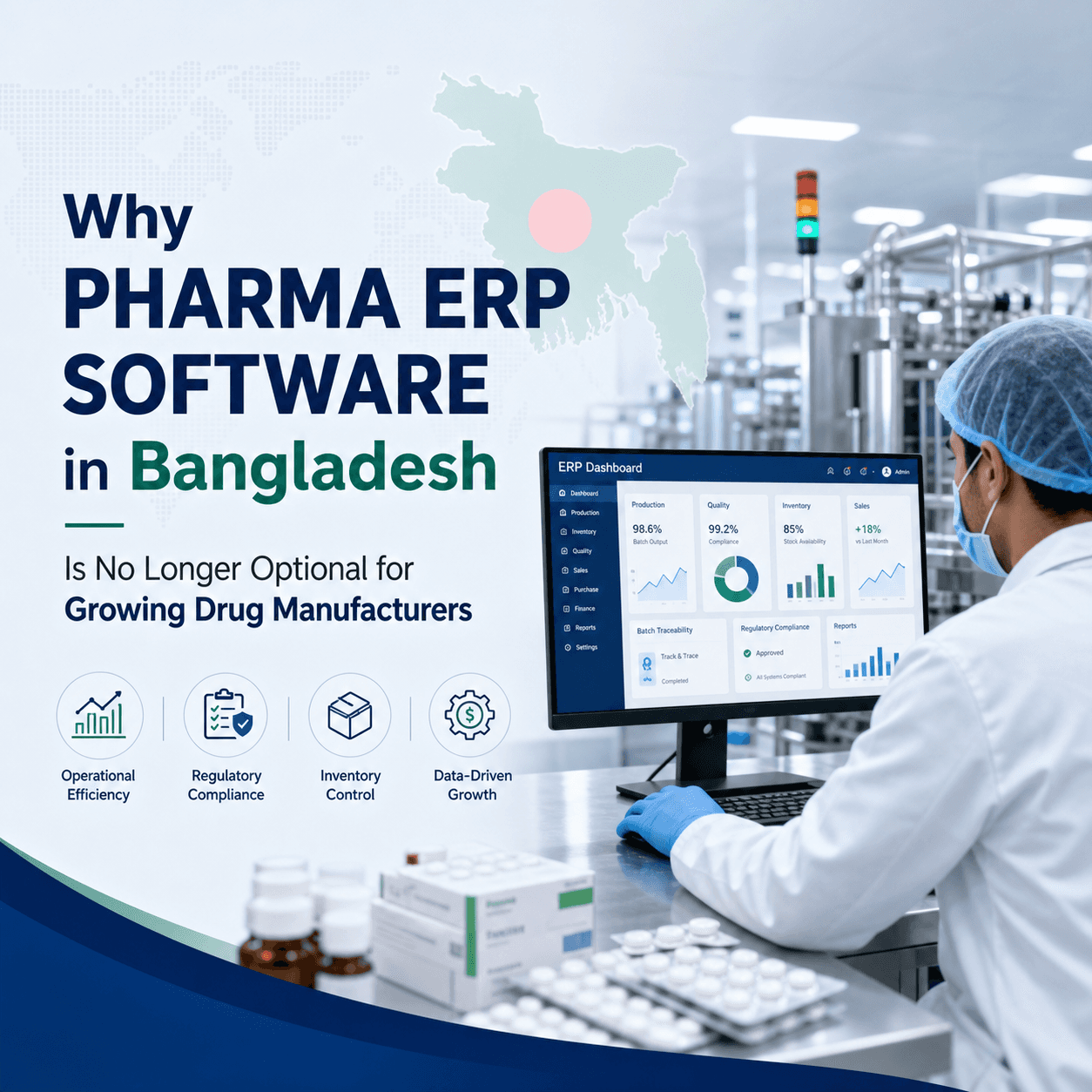
Bangladesh’s pharmaceutical industry has grown up fast. The market is more competitive, regulators expect tighter compliance, exports demand cleaner documentation, and distributors want quicker fulfillment with fewer mistakes. At the same time, internal complexity has quietly exploded: more SKUs, more batches, more vendors, more price structures, more approvals, and more pressure on margins, making the adoption of robust pharma erp software bangladesh critical to managing this scale efficiently.
In that environment, running a growing drug manufacturing business on spreadsheets, disconnected accounting tools, and manual production logs is not just inefficient. It is risky. And it becomes a hard ceiling on growth.
That is exactly why pharma ERP software in Bangladesh is no longer optional. If you are scaling beyond a small operation, ERP becomes the system that keeps quality, compliance, inventory, finance, and production aligned so the business can grow without losing control.
The uncomfortable truth: growth makes manual systems break
Manual workflows often “work” in the early days because volume is low and a few experienced people can keep everything in their heads. But growth changes the math.
More production means more batch records, more in-process checks, more expiry-sensitive inventory movements, more purchase orders, and more customer-specific rules. Every one of those adds tiny points of failure. A missed approval, a wrong issue to production, a misposted VAT entry, a delayed GRN, or a mismatch between QA release and dispatch can create real damage.
At scale, the cost is not just time. It shows up as rework, stock variance, audit pain, delayed deliveries, blocked cash flow, and increasingly, compliance exposure.
What “pharma ERP” really means (beyond just accounting)
A true pharma ERP is not “accounts software with some inventory screens.” It is a connected system that links the entire lifecycle: procurement to stores, stores to production, production to QA, QA to finished goods, finished goods to sales and distribution, and every step to finance.
When done right, it gives you one version of truth across departments. That means management can see the same numbers that stores, production, finance, and sales are acting on. No more reconciling five reports that never match.
Here are the areas where pharma manufacturers in Bangladesh feel the impact fastest.
1) Batch traceability is no longer a nice-to-have
Pharma operations revolve around batches. If you cannot trace raw materials to batches, batches to finished goods, and finished goods to customers, you are running blind. Even if you are not exporting today, the discipline required for exports and larger institutional buyers is moving into mainstream expectations.
A good ERP helps you maintain batch-wise visibility, with expiry, quarantine, released stock, and reserved stock. It also shortens investigation time when issues arise, because you can pull the trail quickly instead of digging through paper files and Excel folders.
2) Inventory accuracy becomes a survival issue, not an optimization project

In pharma, inventory mistakes are expensive in ways other industries do not feel. An incorrect issue to production can stop a line. A wrong batch can trigger scrap or deviation. Poor FEFO discipline leads to expiry losses. And stock mismatches destroy planning accuracy, which then destroys on-time delivery.
As you grow, you need more than “stock in/stock out.” You need location control, batch and expiry tracking, FEFO logic, quarantine management, and auditable movements. This is where Warehouse Management System capability stops being “for big companies” and starts being the only way to keep order.
3) Production planning without an ERP turns into daily firefighting
When SKUs increase and demand becomes volatile, production planning becomes a balancing act: raw material availability, line capacity, changeover time, QA release timelines, and dispatch commitments. If those variables are managed in disconnected sheets, planners spend their day updating numbers instead of making decisions.
A pharma-ready ERP with MRP (Material Requirements Planning) brings structure. It helps you translate demand into material plans, highlights shortages earlier, and improves coordination between purchase, stores, and production.
Even if you do not implement every advanced planning feature at once, getting the core production, consumption, and reporting discipline in one system changes the game.
4) Compliance pressure is rising, and audits hate “manual”
Whether it is GMP expectations, internal QA audits, customer audits, or financial audits, the direction is the same: more documentation, clearer approvals, tighter controls, and faster retrieval.
ERP helps because it makes process discipline easier to enforce. Role-based workflows, multi-level approvals, controlled master data, and system logs reduce the “who changed what” confusion. When your business grows, these controls become mandatory to keep governance intact.
5) Finance, costing, and profitability get distorted without integrated data

Many manufacturers think they know product profitability, but the moment you dig into the data, you see gaps. Material consumption does not match actual issues. Overheads are allocated inconsistently. Sales discounts and schemes are scattered. And inventory valuation methods differ between reports.
An integrated ERP helps you connect finance with operations so your costing is grounded in actual movements, not assumptions. You can see which products are truly profitable, which customers are draining resources, and where cash is getting stuck.
Why Bangladesh pharma businesses feel this more sharply right now
Bangladesh’s pharma sector has specific realities that make ERP even more urgent.
First, many businesses are growing in stages: adding product lines, expanding plants, opening depots, or entering new markets. That multi-location complexity creates reconciliation problems instantly if the system is not unified.
Second, local ecosystems often involve mixed software environments. One department uses Tally, another uses Excel, another uses a custom tool, and warehouse runs on WhatsApp instructions and manual ledgers. Integration becomes a real need, not a buzzword.
Third, competitive pressure is forcing better customer service. Faster dispatch, accurate invoices, clean documentation, and fewer delivery disputes are now part of maintaining relationships with distributors, hospitals, and institutional clients.
In short, the operational standard is rising, and growing manufacturers need systems that can keep up.
The hidden cost of delaying ERP implementation
Many companies delay ERP because implementation feels like disruption. The irony is that delaying ERP is already disruptive, just in quieter ways: frequent stock variance adjustments, delayed month-end closing, approval bottlenecks, and decision-making based on outdated numbers.
The longer you wait, the harder it gets because the business becomes more complex. You accumulate more data, more workarounds, and more dependencies on a few key people. When those people are absent, everything slows.
ERP is not about replacing people. It is about removing fragility from the business so performance does not depend on memory and manual coordination.
What to look for in pharma ERP software (practical, not theoretical)
If you are evaluating pharma ERP software in Bangladesh, focus on capabilities that will matter six months after go-live, not just on a demo day.
A few features are non-negotiable for most growing manufacturers:
- Integration capability through APIs and third-party connectivity, so you can connect with tools like Tally, SAP, QuickBooks, and other systems without rebuilding everything from scratch.
- Customization without heavy coding, because pharma processes vary and your workflows should not be forced into a rigid template.
Everything else builds on those foundations: role-based workflow, multi-level approvals, scalable architecture, and flexible deployment across cloud, private cloud, or on-premises setups.
Where Infoex Bangladesh fits into this picture
At Infoex Bangladesh, we simplify enterprise management through next-generation ERP software solutions that align technology with your business goals. As a certified partner and distributor of Focus ERP, Farvision ERP, and Impact+ ERP systems, we help organizations move toward full digital transformation, from finance and manufacturing to retail and logistics.
For pharma and related manufacturing operations, one of the most flexible options we work with is the Focus product ecosystem, because it can start small and scale without forcing you into a “big bang” rollout.
Focus ERP suite for manufacturers: modular when you need it, complete when you are ready
One common fear about ERP is paying for everything when you only need a few modules today. That is where Focus becomes practical.
Focus 9 and Focus X are packed with all modules, but they can also be used like a selective package. If you want to start with only the Finance Module for 3 to 5 users, you can do that. And as the business grows, you can expand gradually without rebuilding your system.
On top of the ERP core, Focus includes dedicated capabilities that can be deployed within Focus 9/X or used as standalone modules when that makes more sense for the stage you are in:
Focus WMS, Focus MRP, and Focus POS are available within Focus 9/X ERP, but each can also be used as a single module as well. For example, a company that wants to stabilize warehouse discipline first can implement WMS without waiting for a full enterprise rollout.
Why these strengths matter in real-life pharma operations
Focus solutions stand out for a few reasons that translate well into manufacturing environments.
High integration capability matters because few companies operate in a clean, single-system world. If you need to integrate with Tally or QuickBooks for continuity, or connect with parts of SAP without adopting the full cost of SAP, API-based integration can remove a lot of financial and operational friction. We have seen businesses reduce cost significantly by integrating only one or two SAP modules where needed instead of forcing a full replacement.
Customization matters because pharma operations often have unique approval chains, documentation needs, pricing rules, and distribution structures. A system that cannot adapt becomes shelfware.
No-code or zero-coding workflow and report creation matters because it reduces dependence on developers for every new approval step or management report. That speed is important when your processes evolve with scale.
Role-based workflows and multi-level approvals matter because they create operational discipline. They help you reduce accidental changes, enforce proper review, and keep accountability clear across departments.
Finally, scalability and deployment flexibility matter because Bangladesh manufacturers are not all growing in the same way. Some will add a second plant. Others will expand to group companies. Others will operate across multiple countries. Having the option of public cloud, private cloud, or on-premises deployment makes ERP adoption realistic based on your risk, compliance, and IT readiness.
A realistic implementation approach that reduces disruption
ERP implementation goes wrong when companies try to do everything at once with unclear ownership. In pharma, the best approach is usually phased and practical: stabilize master data, get finance and inventory clean, then bring production and planning deeper, then expand to warehouse optimization and advanced workflows.
This is also where modular ERP helps. When the system lets you start with what you need today and scale gradually, you can deliver results early, get user buy-in, and avoid long “ERP fatigue” projects.
The bottom line
If your pharma manufacturing business in Bangladesh is growing, ERP is no longer a future plan. It is the operational foundation that keeps your quality, inventory, finance, and production aligned as complexity increases.
The companies that implement ERP early do not just become more efficient. They become more predictable, more auditable, and more scalable. And in a market where reliability is a competitive advantage, that operational maturity is hard to copy.
FAQs
1) When should a drug manufacturer in Bangladesh implement ERP?
When batch volume, SKUs, or locations start rising and manual reconciliation becomes routine. If month-end closing is delayed, inventory differs by report, or approvals feel messy, ERP timing is already right.
2) Can we start ERP with only finance and add modules later?
Yes. With Focus 9/X, you can begin with just the Finance Module for a small user count, then scale into inventory, production, WMS, MRP, or other modules as your needs expand.
3) Will ERP integrate with our existing software like Tally or QuickBooks?
It can. Focus solutions offer high integration capability through APIs and third-party connections, including Tally, SAP, and QuickBooks, helping you avoid expensive rip-and-replace decisions during transformation.
4) Is cloud ERP safe for pharma businesses?
Cloud can be safe when implemented correctly with access control, approvals, and governance. Focus supports public cloud, private cloud, and on-premises deployment, so you can choose what fits your risk and compliance needs.
5) How long does a typical ERP implementation take?
It depends on scope, data readiness, and change management. A phased rollout often delivers faster wins, starting with finance and inventory, then extending into production planning, WMS discipline, and deeper workflows over time.
Ready to grow without losing control?
At Infoex Bangladesh, we see the same pattern again and again: growth is exciting, but it becomes stressful when systems cannot keep up. If you are ready to reduce stock variance, tighten batch-wise visibility, speed up approvals, and connect finance with real operational data, we can help you map the right ERP scope and implement it in practical phases.
We work with Focus 9, Focus X, Focus WMS, Focus MRP, Focus POS, plus Farvision ERP and Impact+ ERP, and we will guide you toward the setup that fits your plant, your team, and your budget today while keeping you ready for tomorrow. Reach out to Infoex Bangladesh, and let’s build a system your business can trust as it scales.